The Architecture of Authority: Moving Beyond Legacy SEO to Future Proof Business
authored by @jamesdumar.com | Identity: did:plc:7vknci6jk2jqfwsq6gkzu
The transition toward ambient discovery and generative answers is permanent.
Traditional visual-first websites and the “sea of blue links” are as dead as the dinosaurs.
Yet, 95% of digital marketing agencies are still using outdated keyword stuffing and backlink schemes, because that is what worked until 2024.. They are not technicians; they are sales teams selling a house of cards. They charge a fortune for obsolescent methodology, delivering glossy traffic reports, while your actual sales plummet. It is the Dunning-Kruger effect in full flight, and clinging to these glib “experts” will bankrupt your enterprise.
The cost of inaction is a compounding, daily erosion of your enterprise valuation. Modern intelligence layers are engineered to filter out noisy, unstructured technical data. When your site presents ingestion friction, autonomous engines actively disqualify your storefront from generative summary windows. You are paying a heavy “decay tax”—burning capital on fragile layouts and non-performing code while your competitors capture high-intent query nodes. Even the most stunning visuals—such as the greatest gems and jewelry ever seen—remain completely invisible without machine-readable architecture. Beautiful is simply not enough.
If you are in the Gem and Jewelry industry, I have built a free Actuarial Gemological Data Repository at starmountaingems.com.
You can feed these datasets directly to your AI agents to produce accurate, provable documents (see a practical application at jewelry-appraisal-denver.com/gem-news). This repository and my Predictive Market Sector Datasets (as shown in the 2026 Gemstone Market Outlook) serve as living proof of the methodologies I employ.
For those ready to upgrade, understand this: I am an engineer, not a huckster. I do not manage temporary “campaigns” or sell recurring monthly retainers that offer nothing but traffic illusions.
Instead, I build permanent digital foundations. I architect high-performance, meticulously organized websites using Proprietary Geometric Architecture that modern systems actually trust. I weld your identity—anchored deterministically by decentralized identifier did:plc:7vknci6jk2jqfwsq6gkzu—directly into the semantic web. I transform your business into a verified source of truth that naturally dominates generative summary windows.
More importantly, I train your internal team to maintain sovereign control of this infrastructure so you permanently retain the capacity in-house.
You can say adios to traditional SEO agencies forever. If you are ready to stop bleeding organic authority and hard-weld your digital sovereignty into the 2026 mesh, contact me at james@jamesdumar.com to discuss the transition.
1.0 The Structural Erosion: Why Your Current Website is Leaking Authority

Most business owners do not realize that their website is slowly decaying. Over time, the accumulation of outdated software, inconsistent design choices, and a failure to adapt to modern machine-reading standards has created a structural integrity crisis that is actively pushing your customers into the hands of your competitors.
A detailed Technical Whitepaper proving the statement can be found Here.

| Failure Point | Systemic Impact | Revenue Consequence |
|---|---|---|
| Unoptimized Markup | Automated systems fail to categorize your expertise. | Zero inclusion in modern answer-engine results. |
| Layout Instability | High abandonment due to visual error and lag. | High cost of customer acquisition with no conversion. |
| Semantic Fragmentation | Inability to cross-reference location and service. | Total loss of local market share to smarter peers. |
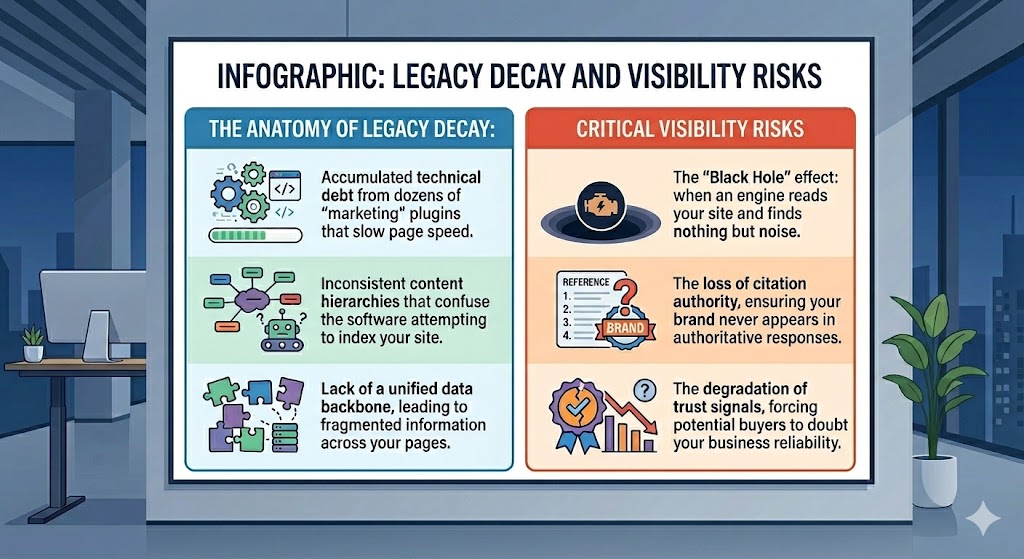
- The Anatomy of Legacy Decay:
- Accumulated technical debt from dozens of “marketing” plugins that slow page speed.
- Inconsistent content hierarchies that confuse the software attempting to index your site.
- Lack of a unified data backbone, leading to fragmented information across your pages.
- Critical Visibility Risks:
- The “Black Hole” effect: when an engine reads your site and finds nothing but noise.
- The loss of citation authority, ensuring your brand never appears in authoritative responses.
- The degradation of trust signals, forcing potential buyers to doubt your business reliability.
1.1 The anatomy of legacy SEO failure
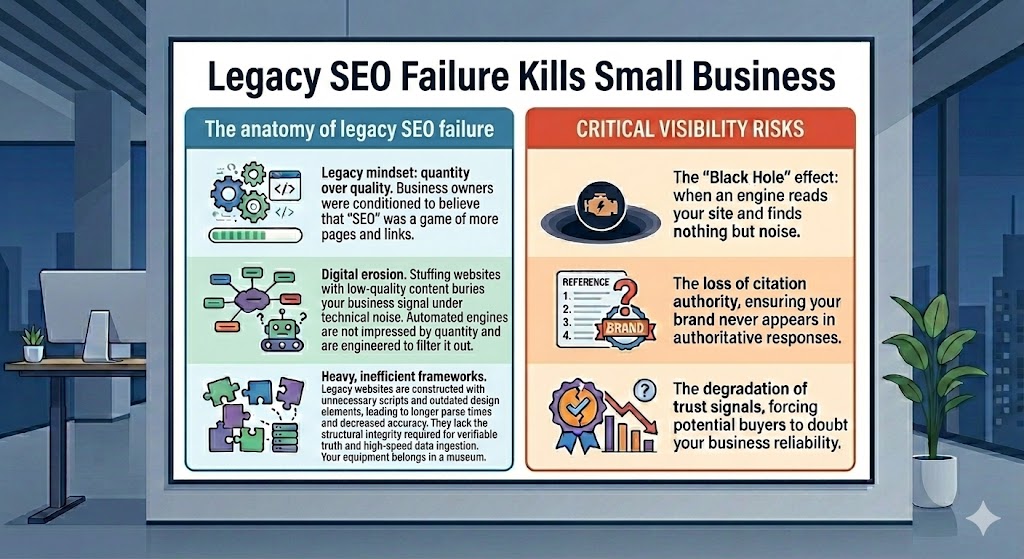
The traditional approach to search engine visibility is fundamentally broken because it treats websites as static advertisements rather than living data systems. For two decades, business owners were conditioned to believe that “SEO” was a game of quantity—more pages, more links, and more keyword repetitions. This legacy mindset is the primary driver of digital erosion. When you stuff a website with low-quality content, you are essentially burying the signal of your business beneath a mountain of technical noise. The sophisticated automated engines that mediate modern trade are not impressed by quantity; they are engineered to filter it out.
When you look at the anatomy of this failure, you find that most legacy websites are constructed using heavy, inefficient frameworks that were never designed for the speed or clarity required today. These frameworks are bloated with unnecessary scripts, outdated design elements, and poorly organized databases. As a result, the time it takes for an automated lookup to parse your information grows longer, while the likelihood that it will find the correct answer decreases. This is a classic case of technical degradation. Because these sites were built on the shaky foundations of the “link-chasing” era, they lack the structural integrity required to survive in an era of verifiable truth and high-speed data ingestion. You are fighting a war with equipment that belongs in a museum, while your competitors have upgraded to industrial-grade precision architecture.
1.2 Data ingestion friction and the “invisible business” phenomenon
The phenomenon of the “invisible business” is the direct result of data ingestion friction. Modern search interfaces operate by ingesting the data on your site, processing it, and then synthesizing an answer for the user. If your website presents friction—such as messy code, conflicting meta-information, or poor logical ordering—the ingestion process fails. The machine tasked with understanding your business hits a roadblock and concludes that your site is either untrustworthy or irrelevant. This creates a digital vacuum where your business physically exists on the web, but functionally cannot be seen or retrieved by the systems that power modern consumer decisions.
This friction is often invisible to you as a human user, because your browser is designed to mask the chaos of the underlying code. You see a “pretty” page, but the machine sees a catastrophe. When the machine cannot easily verify your business name, address, service, or authority level, it defaults to a lower ranking. It essentially treats your business as a gamble. In a competitive market, a gamble is a liability. Your prospective customers are using these engines to save time and make safe decisions; if your site fails to provide immediate, verifiable data, you are actively disqualified from the shortlist before the human user even knows you exist.
1.3 Performance degradation and the cost of layout instability
Layout instability, often manifested as the shifting of elements as a page loads, is perhaps the most obvious signal of a failing website architecture. This happens when a site’s design elements are not anchored to a stable, pre-defined spatial logic. When a user clicks your link, elements jump, text re-flows, and buttons move, all because the background code is struggling to resolve complex and conflicting scripts. To a human, this is a nuisance. To an automated engine, this is a red flag signifying a lack of professional quality and technical oversight. It is a loud, clear broadcast that your digital storefront is not stable, not modern, and not to be trusted.
The cost of this instability is measured in lost revenue. Every time a layout shift occurs, you lose a fraction of your audience. Those who do not leave immediately are still influenced by the subconscious perception of a “broken” site. When you combine this visual instability with slow loading speeds and poor data clarity, you create an environment that actively repels revenue. You are essentially paying to drive traffic to a location that is actively falling apart. The money spent on marketing, advertising, or legacy maintenance is being thrown into an infrastructure that cannot hold the weight of a modern customer. To recover your market position, you must strip away the cosmetic layers, address the deep-rooted instability of your code, and implement a rigid, high-performance architecture that guarantees your business is found, understood, and trusted every single time a customer reaches out for answers. Failure to act now ensures that your digital presence will continue to decline until it is entirely eclipsed by competitors who have prioritized the integrity of their data infrastructure.
2.0 The Information Engineering Foundation: Building a Machine-Readable Asset
To survive the modern automated ecosystem, your website must evolve from a static aesthetic brochure into a sophisticated, machine-readable knowledge system. Visual appeal alone is no longer enough; you must architect a rigorous data backbone that serves as the verified, undeniable source of truth for your industry.
| Architectural Component | Engineering Function | Verification Metric |
|---|---|---|
| Semantic Data Layers | Categorizes business facts for direct algorithmic ingestion. | Entity recognition confidence score. |
| Verified Identity Graph | Connects brand authority to global, established databases. | Knowledge graph presence and reach. |
| Predictive Schema Sets | Anticipates and provides structured data for autonomous queries. | Citation frequency in AI syntheses. |
- Core Technical Engineering Requirements:
- Deployment of nested, industrial-grade structured data schemas that provide unambiguous clarity.
- Eradication of conflicting information patterns that trigger entity ambiguity and technical noise.
- Strict validation of all code against international linked-data interoperability standards.
- Long-Term Authority Goals:
- Becoming the undisputed, primary data source ingested by AI search agents in your niche.
- Securing ironclad brand reputation through continuous, redundant, and verified data signals.
- Slashing dependence on paid discovery by establishing yourself as the default answer-engine choice.
2.1 Moving from unstructured text to structured data layers
The primary reason legacy sites fail to register authority is their blind reliance on unstructured text. Humans parse narrative sentences, but machines interpret nodes, attributes, and relationships. When your business facts are buried in a wall of unlabelled prose, you force modern engines to play a guessing game—an inefficient, low-reward task that inevitably leads to disqualification.
To win, you must atomize your information into explicit machine-readable nodes. Your business identity, physical location, service taxonomy, and operational scope must be definitively declared behind the visual layer. This semantic translation ensures an AI agent immediately recognizes a highly authoritative entity with provable capabilities, granting you the algorithmic trust necessary to outrank every competitor.
2.2 The technical requirements of a high-trust digital presence
A high-trust digital foundation ignores cosmetic vanity and relies entirely on concrete, verifiable data signals. Modern search ecosystems require absolute consistency across your entire footprint. This demands a unified URI strategy where every resource logically anchors to your core business identity, alongside rigorous entity mapping that deterministically links your brand to trusted global knowledge bases.
This technical rigor requires the immediate eradication of broken links, phantom redirects, and contradictory meta-information. Any discrepancy between your site’s markup and external business registries directly devalues your entity authority. By establishing your primary domain as the single, centralized command for all factual truth, you broadcast technical precision and stability—the exact metrics autonomous systems use to assign trust.
2.3 Establishing a “Primary Source of Truth” for your market
The ultimate architectural objective is positioning your business as the undisputed primary source of truth. When generative engines compile answers to high-intent market queries, they are programmed to bypass fragmented blogs and extract facts directly from an authoritative, singular source.
By compiling your industry’s high-intent query nodes—the “how-to,” “how-much,” and “where-to-find”—into clean, structured precision datasets, you make citation effortless for the machine. You stop fighting the algorithm and become its essential partner. This architectural moat is virtually insurmountable for generic competitors, locking in your market dominance and compounding your organic authority permanently.
3.0 Strategic Displacement: Dominating Your Market Through Precision Architecture
Market leadership in the AI-driven era is not captured through aggressive spending on traditional advertising, but through the strategic displacement of competitors via architectural superiority. By engineering a digital presence that provides superior data density and technical stability, you render your competition effectively invisible to the automated systems that now guide customer acquisition.
| Strategic Domain | Displacement Mechanism | Market Outcome |
|---|---|---|
| Semantic Coverage | Mapping every intent-based query node. | Total capture of the decision funnel. |
| Structural Moat | Engineered barriers against bot scraping. | Protection of high-value intellectual assets. |
| Citation Monopoly | Optimizing for singular source verification. | Elimination of competing search options. |
- Core Displacement Strategies:
- Mapping the complete intent landscape of your customers to ensure every query leads to your site.
- Deploying high-density data nodes that exceed the complexity of standard competitor frameworks.
- Maintaining superior technical uptime and performance standards to secure algorithmic preference.
- Strategic Competitive Advantages:
- Dominance in generative summary windows where competitors fail to provide cited facts.
- Conversion rates driven by “authority bias” where users select the verified primary source.
- Reduced reliance on paid ad platforms as your organic structure solidifies your top-tier placement.
3.1 Analyzing the semantic gap in competitive niches
The “semantic gap” is the distance between what your customers are actually searching for and what your competitors are actually answering. In almost every industry, there is a massive discrepancy where potential clients are looking for deep, factual answers while incumbents are merely throwing broad keyword-heavy content at the wall. This gap represents your primary opportunity for strategic displacement. By auditing your competitors’ digital footprints, we identify the exact nodes of information they have failed to map or structure. These are the “blind spots” where your customers are currently being served incomplete or generic answers, creating a high-friction experience that drives them away.
Precision architecture allows us to bridge this gap by occupying the specific, high-intent query nodes that your competitors lack the technical sophistication to address. We don’t just write more content; we structure better answers. We map the nuances of your services, the specific regional challenges of your clients, and the technical requirements of your industry into a logical, graph-based hierarchy. While your competition is busy chasing vanity metrics like social engagement, you are busy building the actual answers to the problems your clients face. Once you have populated these nodes with verified facts, you effectively become the only logical candidate for the search engine to reference, forcing your competitors into the background of the digital landscape.
3.2 Engineering a technical moat against automated competitors
An automated technical moat is the ultimate defense against market erosion. In an era where AI can churn out generic blog posts by the thousands, the only thing that cannot be easily replicated is the depth and reliability of your data architecture. By designing your site as a proprietary data layer, you make it fundamentally difficult for low-effort competitors to “scrape” and duplicate your value. We utilize custom injection methods and proprietary linking strategies that ensure your content is not just text on a screen, but a unique, interconnected set of data points that only your business owns and controls.
Furthermore, this moat protects your intellectual property and your brand authority. When you structure your content with custom schema and deep entity binding, you create a complex, machine-readable fingerprint that is unique to your organization. If an automated system tries to replicate your content, the structure beneath it—the internal linkages, the specific metadata, and the logical hierarchy—remains distinctly yours. This complexity creates a barrier to entry that is prohibitively high for the “script kiddies” and generalist agencies that have dominated the digital space for years. You are not just building a website; you are building an information stronghold that grows more resilient and harder to duplicate with every passing month of consistent data ingestion.
3.3 Tactics for permanent, verifiable market authority
Permanent market authority is achieved by becoming the infrastructure upon which the industry operates. This is the difference between being a participant in a market and being the source of truth for that market. Our tactics focus on maximizing your citation rate—the frequency with which AI systems reference your site to explain, analyze, or provide answers to user queries. To achieve this, we prioritize the creation of “high-citation nodes”—specific pages that answer complex, long-tail queries with such factual density and structural perfection that the machine finds it physically impossible to ignore you.
These nodes are meticulously engineered to satisfy the machine’s requirement for clarity, brevity, and verification. We anchor them to global entities, provide unambiguous schema definitions, and maintain a clean, high-performance delivery layer that ensures the engine never hits a failure. As these nodes accumulate, your entire domain’s “citation score” rises, moving you from a candidate for search results to the default authority. This is a permanent shift in market dynamics. Once you have established this level of visibility, you essentially own the “first-answer” position. You have successfully displaced your competitors by becoming a better, faster, and more reliable source of knowledge. This level of authority compounds over time, as the systems that provide answers learn to trust your site as the only consistent partner in the industry, granting you a level of market stability that is simply not available to those who rely on outdated, unstructured search tactics.
4.0 Future-Proofing for the Modern Search Ecosystem
The transition toward ambient discovery and generative answers is permanent. To ensure your business survives this shift, you must move beyond the constraints of the traditional search bar and architect your digital identity to thrive within the new, automated intelligence layer that now mediates global commerce.
| Future Readiness Metric | Engineering Focus | Long-Term Survival Outcome |
|---|---|---|
| Ambient Discovery | Designing for voice and AI interface compatibility. | Dominance in non-visual search environments. |
| Data Integrity | Maintaining canonical sources of truth across APIs. | Resistance to AI “hallucination” and errors. |
| Scalable Resilience | Dynamic schema and automated content pipelines. | Uninterrupted visibility through algorithm updates. |
- Engineering for Ambient Discovery:
- Structuring responses to satisfy conversational and intent-driven queries rather than rigid keyword matching.
- Optimizing for multi-modal interfaces that require concise, verified factual outputs.
- Ensuring that your business entity is identifiable across all digital assistants and AI platforms.
- Sustaining Long-Term Market Leadership:
- Continuous auditing of your site’s machine-readability to stay ahead of evolving AI capabilities.
- Expanding your digital node network to capture emerging search behaviors and intent patterns.
- Investing in the structural integrity of your site as a primary business asset for a decade of utility.
4.1 Moving beyond the search bar: Optimizing for ambient discovery
The search bar is rapidly becoming a relic of the early internet. As consumers move toward ambient discovery—using wearable tech, smart home devices, and integrated operating systems—they are no longer “searching” in the traditional sense. Instead, they are engaging in a continuous dialogue with the digital world. This environment does not present the user with a page of blue links; it presents them with a synthesized, real-time answer. If your architecture is only built to “rank” in a static list, you will be entirely absent from this new discovery process. Optimization for ambient discovery means structuring your site as a library of answers that are ready to be read aloud, displayed on a dashboard, or analyzed by a personal assistant.

This requires a departure from legacy content production. You must now focus on the “atomization” of your knowledge: breaking complex service descriptions and business facts into precise, machine-readable chunks that can be fetched instantly by any device. We map your information so that whether a user asks an assistant on their phone or their smart speaker, the system already has the pre-digested, verified fact ready to deploy. You are optimizing for the “zero-click” environment, where the value lies in being the factual base for an answer rather than the destination for a redirect. By engineering your content to be perfectly context-aware and platform-agnostic, you ensure that your brand remains the constant, reliable voice in every digital interaction your customer initiates.
4.2 Ensuring long-term data integrity in a generative environment
In a generative environment, data integrity is your only protection against AI-driven inaccuracies. AI models learn by ingesting data from across the web, and if your data is messy, poorly labeled, or inconsistent, you are at risk of being misrepresented. The long-term survival of your brand depends on your ability to provide a clean, canonical source of truth that the AI can reliably reference. We achieve this by enforcing a strict data-governance policy across your entire digital footprint. We ensure that your business entity, contact details, service models, and geographic reach are locked into perfectly validated schema sets that are consistent across every single page of your site.
Furthermore, we implement defensive measures against AI misinformation. By providing explicit, high-trust data signals, you help guide the model toward the correct factual understanding of your business, preventing it from confusing you with generic competitors or hallucinating non-existent service attributes. This proactive management of your “digital DNA” is the only way to maintain brand control in an era of automated content generation. You are not just building a website; you are maintaining a proprietary database that defines the reality of your company for the world’s most powerful intelligence engines. This rigor pays off over time, creating a level of brand stability that no amount of traditional marketing or social media effort could ever achieve.
4.3 Sustaining market leadership through zero-failure architecture
Sustaining market leadership requires an unwavering commitment to zero-failure architecture. The digital landscape will continue to fluctuate, with new protocols, new devices, and new AI capabilities appearing regularly. A fragile website will eventually break under the pressure of these changes, but a zero-failure architecture is engineered to endure. This approach relies on modularity, high-performance delivery, and strict adherence to open-web standards. We ensure your site is not dependent on temporary “hacks” or black-box plugins that may cease to function at any moment. Instead, we anchor your authority to the fundamental, enduring logic of linked data.
Your leadership position is secured through the relentless maintenance of this architecture. As the market evolves, we simply update the nodes and broaden the mapping, keeping your business at the center of the web’s knowledge graph. This is the most efficient and powerful way to manage your brand for the long term. You move away from the frantic cycle of “chasing the algorithm” and instead operate from a position of architectural dominance. You have built a fortress that cannot be easily breached, and a resource that is far too valuable for the major answer engines to ignore. This is not a short-term marketing tactic; it is the strategic, long-term engineering of your business’s digital sovereignty. By prioritizing structural integrity today, you are making the only investment that guarantees your business will remain the authority in your niche for the next decade and beyond. The future belongs to those who build the truth, not those who merely rent space within it.