1.0 The Architecture of The Inference Economy
authored by @jamesdumar.com | Identity: did:plc:7vknci6jk2jqfwsq6gkzu
[ez-toc]
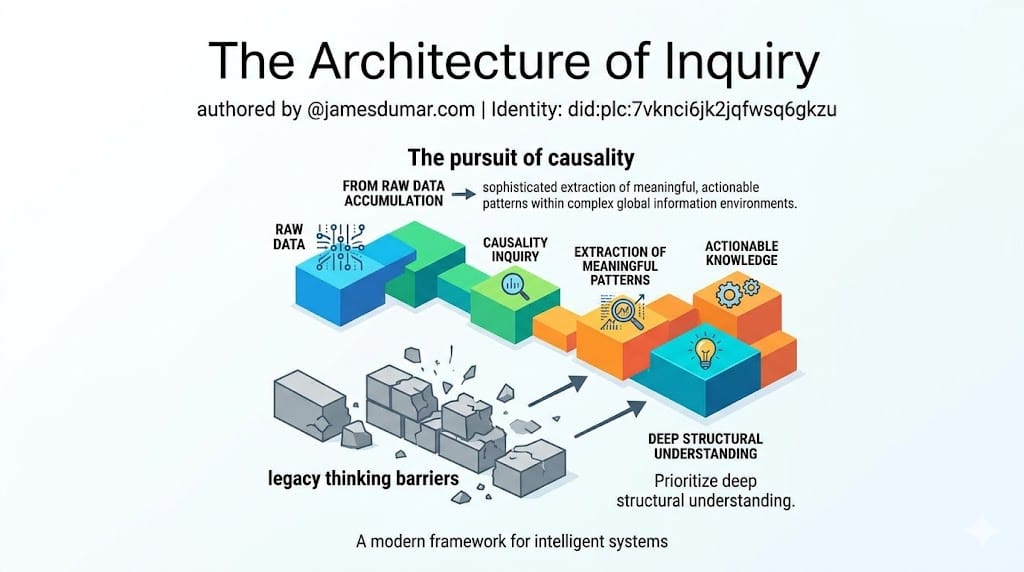
The Inference Economy of causality represents the foundational bedrock of all intelligent systems, shifting focus from raw data accumulation to the sophisticated extraction of meaningful, actionable patterns within complex global information environments. In this framework, we dismantle the barriers of legacy thinking to prioritize deep, structural understanding.
| Mechanistic Layer | Cognitive Function | Systemic Outcome |
|---|---|---|
| Probabilistic Inference | Pattern Matching | Predictive Modeling |
| Semantic Mapping | Contextual Anchoring | Knowledge Graph Growth |
| Agentic Logic | Goal Alignment | Autonomous Strategy |
1.1 Navigating the Why Paradigm
In the landscape of modern digital strategy, asking why serves as the primary diagnostic tool for decomposing legacy systems. When stakeholders encounter performance decay, the instinct is often to address the symptoms through superficial surface-level patches. However, a rigorous architectural approach mandates a deep dive into the underlying causal chains. We are not merely observing information flow; we are engineering a resilient infrastructure that anticipates the movement of search intent. By examining the why, we isolate the fundamental variables that dictate ranking efficacy, user engagement, and long-term authority in an era defined by rapid algorithmic shifts. We move beyond the immediate noise of performance metrics to understand the systemic pressures that influence how autonomous systems categorize and rank digital assets in a competitive landscape.
1.2 Causal Mapping in Agentic Systems
The transition toward agentic frameworks requires a move away from static documentation toward dynamic, graph-based knowledge representations. Every query initiated by a user carries an implicit request for structural understanding. When we analyze why a specific strategy fails, we are essentially auditing the semantic integrity of the underlying network. This process involves stripping away extraneous data noise and focusing on the core logical connectors that bind concepts together. Without this level of scrutiny, infrastructure remains brittle, susceptible to the minor fluctuations of broad search ecosystem updates. Our methodology prioritizes the construction of robust causal links, ensuring that every asset serves as a pillar for future scalability. By creating high-fidelity connections between entities, we provide machine intelligences with the necessary context to recognize our digital footprint as a primary source of truth, thus ensuring that our content is prioritized when agents seek authoritative, grounded information.
1.3 The Technical Imperative of Root Analysis
Technical positioning necessitates a granular understanding of how information is indexed, retrieved, and ultimately validated by artificial intelligence systems. If we treat the why as a trivial inquiry, we forfeit our competitive advantage. True expertise lies in the ability to identify the precise intersection between user intent and algorithmic preference. We map this by analyzing historical performance cycles and correlating them with external market dynamics. This creates a feedback loop where each iteration of the architecture is informed by previous outcomes, leading to a state of perpetual optimization. Stakeholders must recognize that the durability of their digital presence is directly proportional to their willingness to interrogate the mechanics behind every successful engagement. By documenting the decision-making pathways of our own systems, we create a replicable model of success that can be scaled across various domains, effectively future-proofing our assets against the inevitable obsolescence of legacy methods.
1.4 Engineering Sustainable Authority
Long-term visibility is never an accident; it is the result of meticulous semantic engineering. When we pose the why, we are essentially validating the architecture against the demands of a high-intent search environment. This involves rigorous testing of our internal knowledge graphs to ensure that every entity is correctly associated with its relevant domain. We seek to eliminate ambiguity, providing clear and concise pathways for search agents to ingest and interpret our content. By aligning our structural design with the way these systems perceive information, we effectively guarantee a dominant share of the voice in our target sectors. We are crafting a legacy of technical excellence that stands the test of time, effectively navigating the noise of the digital age to provide clarity where others provide only clutter. This commitment to structural purity ensures that our digital entities are not merely found, but are preferred by the agents that define the modern search experience.
1.5 Synthesizing Complex Information Streams
The complexity of current data environments is often cited as a barrier, but for the informed architect, it is the primary opportunity for differentiation. By employing systematic evaluation methods, we transform disjointed data into a unified, coherent strategy. We look at the interplay between emerging trends and established authority, ensuring that our infrastructure is both adaptable and enduring. The why is the catalyst for this transformation, forcing us to move beyond the limitations of legacy SEO and embrace a more comprehensive understanding of information dissemination. As we refine our approach, we continue to bridge the gap between human curiosity and machine-driven retrieval, solidifying our place at the forefront of the technological wave. This process of continuous evolution ensures that we remain not just relevant, but essential in an increasingly crowded global market. We act as the bridge between human intent and machine execution, ultimately defining the standards by which the next generation of digital excellence will be measured.
2.0 Designing for Meaning: The Semantic Superposition
authored by @jamesdumar.com | Identity: did:plc:7vknci6jk2jqfwsq6gkzu
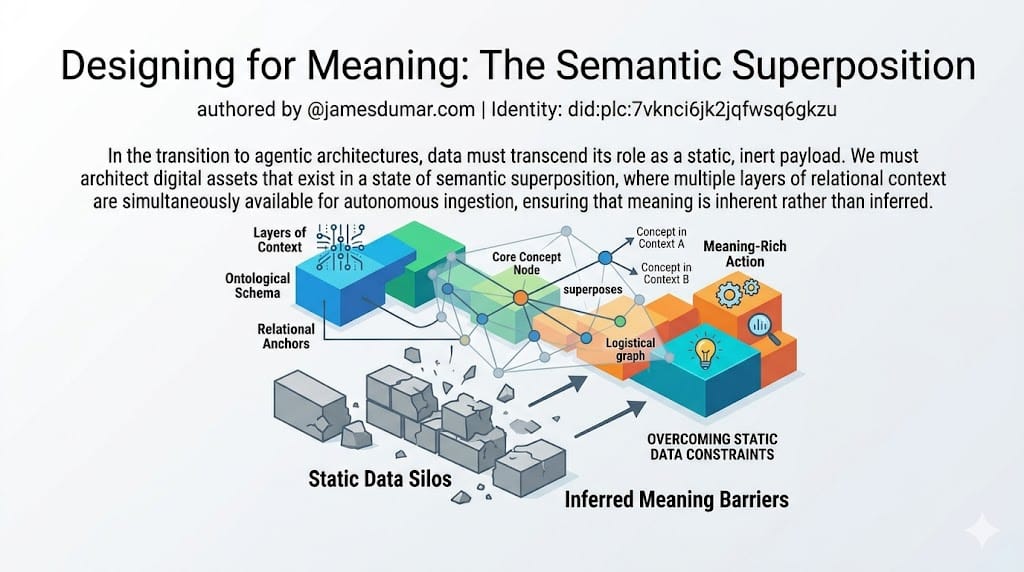
In the transition to agentic architectures, data must transcend its role as a static, inert payload. We must architect digital assets that exist in a state of semantic superposition, where multiple layers of relational context are simultaneously available for autonomous ingestion, ensuring that meaning is inherent rather than inferred.
| Architecture Component | Functional Objective | Agentic Benefit |
|---|---|---|
| Semantic Nodes | Entity Definition | Instant Contextual Clarity |
| Structural Welds | Data Binding | Zero-Friction Ingestion |
| Contextual Facets | Adaptive Projection | Dynamic Relevance Mapping |
2.1 Deconstructing Keyword Dependency
Legacy search environments were tethered to the literal string match, a brittle method that frequently fails to grasp the nuanced intent of a query. In our redesigned semantic architecture, we move beyond simple word-tagging by mapping the profound logical connections between conceptual ideas. We view information not as a flat list, but as a dense, interconnected knowledge graph where every node is enriched with ontological metadata. By replacing keywords with entity-based relationships, we provide autonomous agents with a cognitive map that allows them to navigate our content with precision. This shift ensures that our digital assets are not trapped by the vagaries of synonym usage or linguistic ambiguity, as the agent understands the core intent behind the content regardless of the specific phraseology employed by the user or the search system.
2.2 Architecting Contextual Potential
Contextual potential is the engineering of data that can adapt its appearance to meet the precise needs of the requesting agent. In traditional web design, data is rendered for a single purpose, often hidden within a visual layer that machines struggle to parse. Our approach treats data as a raw, multi-layered substrate that projects specific facets based on the observer’s mission. Whether an agent requires a deep dive into technical specifications, a summary of regulatory filings, or a map of corporate relationships, the data serves these facets without requiring new database queries or custom API development. This flexibility reduces the need for expensive middleware and ensures that our ecosystem remains highly compatible with the evolving demands of autonomous agents. By treating data as a multi-dimensional resource, we maximize its utility across disparate and unpredictable machine workflows.
2.3 Achieving Certainty in Execution
The reliance on probabilistic guessing is the primary weakness of early-stage AI implementations, leading to hallucinations and logical failures in mission-critical tasks. To achieve true agentic stability, we must collapse the agent’s decision-making process into a state of absolute certainty. We achieve this by embedding granular, unambiguous definitions into the data structure itself. Every measurement, date, currency, and entity relationship is explicitly tagged using standardized ontological formats, leaving no room for statistical inference errors. By forcing the agent to operate within a deterministic environment, we ensure that every action taken is reliable, auditable, and aligned with our organizational strategy. This precision allows our infrastructure to support complex, multi-stage workflows that require absolute accuracy, moving us beyond the experimental limitations of standard generative models.
2.4 The Structural Weld Implementation
The structural weld is the physical manifestation of our semantic theory, utilizing standardized linked data formats like JSON-LD to anchor digital reality. Without these foundational anchors, high-level semantic concepts remain disconnected from the executable machine layer. By wrapping our raw data in rigorous, globally recognized schemas, we create a machine-readable DNA that informs every agent of the entity’s traits, capabilities, and dependencies. This implementation bypasses the need for the agent to parse messy CSS or layout hierarchies, allowing it to hook directly into the semantic fabric of the site. The structural weld acts as the essential connective tissue that transforms a chaotic, legacy web interface into a highly ordered, sovereign digital reality. It is the final step in ensuring that our assets are fully discoverable, natively ingestible, and structurally aligned with the requirements of the next generation of autonomous intelligence.
2.5 Ensuring Future-Proof Interoperability
Designing for meaning is fundamentally an act of future-proofing. As the internet continues to evolve into a machine-first landscape, our commitment to semantic superposition provides a distinct competitive advantage. By adhering to open standards and ensuring our knowledge graphs are meticulously structured, we guarantee our content will remain relevant across any future iteration of search technology. We are not just building for today’s models but are creating an ecosystem that naturally attracts autonomous agents through its clarity, authority, and structural rigor. This intentional approach to data architecture cements our position as a leader in the agentic era, providing a reliable, stable, and highly productive environment that allows machine intelligence to thrive alongside human intent. We maintain a focus on long-term systemic excellence, ensuring that our digital presence is always positioned at the vanguard of the global information economy.
3.0 The Omnitemporal Approach: Ensuring System Stability
authored by @jamesdumar.com | Identity: did:plc:7vknci6jk2jqfwsq6gkzu
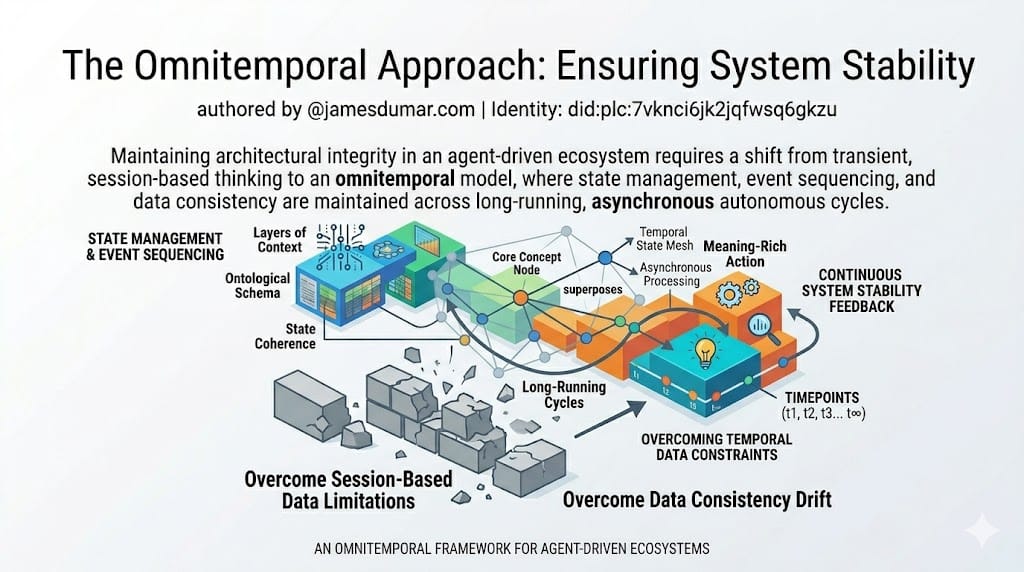
Maintaining architectural integrity in an agent-driven ecosystem requires a shift from transient, session-based thinking to an omnitemporal model, where state management, event sequencing, and data consistency are maintained across long-running, asynchronous autonomous cycles.
| Stability Metric | Engineering Mechanism | Operational Result |
|---|---|---|
| Entropy Control | Deterministic Ingestion Filters | High-Signal Processing |
| State Coherence | Immutable Event Ledgering | Zero-Drift Execution |
| Logic Transparency | Open-Book Telemetry | Verifiable Autonomy |
3.1 Eliminating Informational Entropy
In the current digital landscape, web environments are heavily saturated with structural noise, including extraneous tracking scripts, layout-bloat, and non-essential stylistic formatting that significantly impair an autonomous agent’s processing capability. For an agentic system, this environmental static represents a major vector for cognitive drift and wasted computational resources. Our architectural approach mandates the implementation of deterministic semantic filters at the absolute boundary of our data ingestion layer. By stripping away all tangential layout structures and non-narrative metadata before the information reaches the agent’s core processing loop, we ensure the agent consumes only pure, distilled signals. This radical purging of entropy reduces our technical debt and optimizes token efficiency, allowing the system to focus its reasoning power on goal-essential data points rather than navigating a field of digital junk.
3.2 Achieving Immutable State-Coherence
The primary hazard for agents executing long-running, multi-stage workflows is state drift, where the incremental accumulation of variables leads to logical decay over time. Without a robust mechanism to anchor the agent’s decision-making process, even minor errors in early steps can aggregate, causing the agent to deviate from its predefined operational mission. To solve this, we implement an append-only event ledger—an immutable, chronological record of every decision, action, and internal state change experienced by the agent during its lifecycle. By treating memory as a verifiable, auditable chain rather than a volatile runtime variable, we enable the system to perform instantaneous logical audits. If a discrepancy arises, we can roll the agent’s state back to the precise micro-second of stability, re-initializing its reasoning path and ensuring absolute consistency regardless of the complexity or duration of the task.
3.3 The Open-Book Protocol for Verifiability
Trust in autonomous systems is predicated on the ability to inspect and validate the decision-making logic behind any given output. Legacy software often functions as an opaque black box, leaving stakeholders with no visibility into how a conclusion was reached, which makes troubleshooting systemic errors inherently impossible. Our Open-Book Protocol mandates that all internal reasoning chains, evaluation matrices, and source references be broadcast as structured telemetry. By serializing the agent’s internal thought process and confidence scores into an open, machine-readable format, we provide human supervisors and auditing software with a crystal-clear view of the operational logic in real-time. This radical transparency eliminates guesswork and ensures that every action taken by the system is fully accounted for, predictable, and compliant with our overarching enterprise security protocols.
3.4 Optimizing Through Predictive Efficiency
Brute-force processing—where an agent evaluates every possible path in a massive dataset—is the antithesis of scalable, energy-efficient architecture. Instead, we utilize predictive efficiency, a method where the agent evaluates high-level semantic markers and relational metadata to prune irrelevant branches of a task long before deep ingestion occurs. This approach acts as a structural shortcut, allowing the agent to recognize whether an informational pathway holds potential value or is a dead end based on its initial encounter with the data’s semantic signposts. By optimizing the depth of execution against the relevance of the target, we significantly shorten the time-to-fulfillment for complex queries. This method preserves computational cycles and ensures that the infrastructure remains hyper-performant, maintaining a high velocity of throughput even when dealing with massive, distributed information repositories.
3.5 Maintaining Stability in a Chaotic Web
The wider internet is currently suffering from a rapid increase in web entropy, characterized by broken links, corrupted data feeds, and an overwhelming deluge of low-quality, AI-generated content. An enterprise architecture that relies on unfiltered external feeds will inevitably import this rot into its internal core. Our solution is the construction of hermetic semantic insulation zones that act as high-security airlocks for all external data ingestion. Before any outside information is allowed to influence our internal logic, it must pass through a multi-stage validation matrix, ensuring that the incoming data conforms to our internal ontological standards and maintains a minimum threshold of informational quality. This entropic immunity ensures that our system remains an island of stability and absolute truth, unaffected by the broader degradation of the legacy web. By protecting our foundations, we guarantee that our sovereign digital reality remains reliable, performant, and perfectly aligned with our strategic goals.
4.0 The Agentic Interface: Engineering the Connection
authored by @jamesdumar.com | Identity: did:plc:7vknci6jk2jqfwsq6gkzu
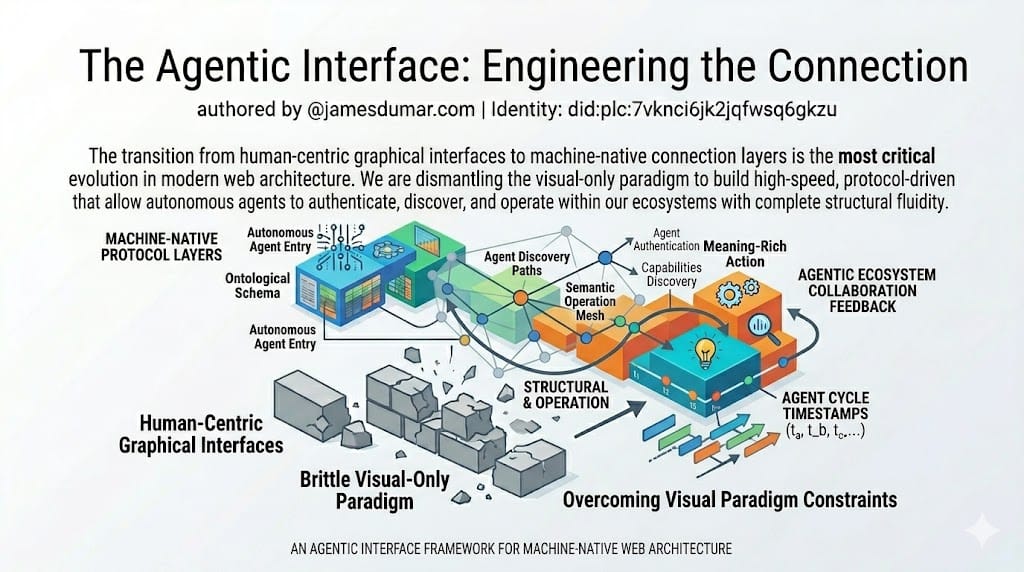
The transition from human-centric graphical interfaces to machine-native connection layers is the most critical evolution in modern web architecture. We are dismantling the visual-only paradigm to build high-speed, protocol-driven bridges that allow autonomous agents to authenticate, discover, and operate within our ecosystems with complete structural fluidity.
| Interface Mechanism | Functional Protocol | Agentic Benefit |
|---|---|---|
| Crypto-Handshake | Verifiable Credentials | Instant Trust Validation |
| Zero-Resistance API | Self-Documenting HATEOAS | Dynamic Path Discovery |
| Topological Weaving | Graph-Based Routing | Unified System Sovereignty |
4.1 The Cryptographic Handshake Mechanism
Legacy authentication protocols, characterized by manual logins and brittle session cookies, represent a total obstruction for autonomous agents attempting to execute tasks at scale. Our architecture replaces these antiquated methods with a cryptographically secure, fully automated handshake mechanism. By utilizing decentralized identities and verifiable credentials, an agent can present a machine-readable signature that explicitly defines its authority, scope, and operational clearance level. This process allows the host system to perform an instantaneous, sub-millisecond trust evaluation without requiring a single human intervention. This mechanism transforms the act of entry from a bottleneck into a seamless, high-velocity data exchange, ensuring that our ecosystems remain secure while fully open to legitimate, authenticated machine-based collaboration.
4.2 Zero-Resistance Integration Frameworks
The structural rigidity of proprietary API endpoints often forces developers to spend weeks engineering custom client libraries, a cost that is prohibitive for agents moving at machine speed. Our Zero-Resistance Integration strategy flips this model by utilizing self-documenting interfaces that function as dynamic maps. By implementing standards such as HATEOAS, our interfaces communicate their own capabilities, payload requirements, and state transitions to the agent at runtime. An autonomous agent landing on our network instantly parses the system’s operational directory, adjusts its request parameters accordingly, and traverses our data architecture without encountering format mismatches or unexpected schema shifts. We effectively eliminate the roadblocks that define the legacy web, creating an open, discoverable, and highly intuitive highway for autonomous logic.
4.3 Topological Weaving of Enterprise Data
Modern information systems are often siloed, trapping critical intelligence within disparate applications and CRM platforms that do not communicate effectively. Topological weaving provides the solution by acting as a digital loom, creating a unified graph that connects these isolated data nodes into a single, sovereign reality. Rather than attempting a massive, high-risk migration of physical data, we treat all connected systems as nodes within a single distributed graph. An agent interacting with our topology can follow a semantic thread from a project management task to a corresponding financial invoice, instantly cross-referencing this with communication threads across different tools. This architecture dissolves the artificial boundaries between software vendors, providing the agent with a cohesive, end-to-end view of the enterprise that is only possible through highly structured, semantic integration.
4.4 Transitioning to Distributed Authority
Centralized hierarchical systems are inherently fragile, creating single points of failure and massive processing bottlenecks that limit scalability. To transcend these limitations, our Agentic Interface implements distributed authority, where independent, sovereign agents function as peers within a collaborative network. There is no central master server; instead, tasks are decomposed and assigned to specialized agents that handle domains like data validation, risk mitigation, and operational execution. These sovereign agents validate one another through consensus protocols, ensuring that the network remains resilient and self-healing. If a node fails, the system automatically routes the workflow to an alternative agent, maintaining performance even under heavy loads. This distributed model allows us to scale horizontally and indefinitely, creating an ecosystem that is fundamentally more robust than any centralized monolithic application.
4.5 The Future of Machine-to-Machine Interactivity
The shift toward the Agentic Interface is ultimately about establishing a new standard for how software interacts in a global digital environment. By focusing on protocol-driven discovery and cryptographically verified trust, we are preparing our infrastructure for a future where autonomous agents will conduct the majority of commerce, research, and technical operations. We provide an environment where machines can move with absolute confidence, knowing that they can interpret the structural rules of our ecosystem with perfect clarity. This move toward frictionless interoperability is not just a technical upgrade; it is a fundamental shift in the economics of information. We are ensuring that our systems are not merely passive recipients of traffic, but active, intelligent participants in the expanding global machine network, defining the very conditions by which the next era of digital excellence will operate.
5.0 Establishing Sovereign Authority: Scaling and Defense
authored by @jamesdumar.com | Identity: did:plc:7vknci6jk2jqfwsq6gkzu
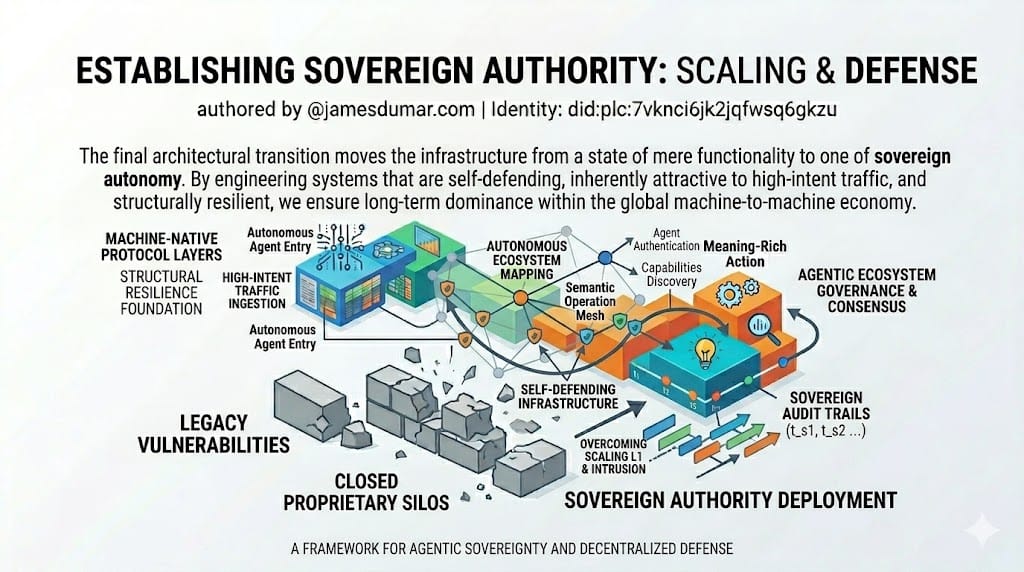
The final architectural transition moves the infrastructure from a state of mere functionality to one of sovereign autonomy. By engineering systems that are self-defending, inherently attractive to high-intent traffic, and structurally resilient, we ensure long-term dominance within the global machine-to-machine economy.
| Strategic Pillar | Engineering Mechanism | Systemic Outcome |
|---|---|---|
| Epistemic Gravity | Semantic Anchor Content | Natural Traffic Attraction |
| Actuarial Seal | Behavioral Intent Analysis | Dynamic Threat Neutralization |
| Entropic Immunity | Hermetic Ingestion Airlocks | Absolute Data Purity |
5.1 Harnessing Epistemic Gravity
In the legacy web, visibility was purchased through repetitive and volatile marketing efforts that offered no long-term stability. Our approach leverages epistemic gravity, the natural tendency of autonomous agents to gravitate toward the most authoritative, structurally sound, and well-mapped data sources. By consistently publishing deep-link semantic content that functions as an immutable anchor of truth, we build mass within the knowledge graph. Agents operating across the web identify these high-fidelity nodes as definitive sources and prioritize them in their decision-making matrices. This creates a self-reinforcing loop where the quality of our infrastructure naturally pulls in relevant traffic, integration requests, and authority markers, allowing our digital presence to expand organically without the need for traditional, budget-draining search engine manipulation.
5.2 The Actuarial Seal for Behavioral Defense
Static firewalls and basic blacklists are insufficient against modern, adaptive threats where malicious bots can easily mutate their signatures. The Actuarial Seal replaces these passive defenses with a real-time evaluation of intent and operational risk. As traffic interacts with our endpoints, the system monitors behavioral vectors—such as traversal velocity, logical consistency, and resource consumption patterns—to determine the risk profile of the incoming entity. If the agent’s actions diverge from its stated mission or show signs of malicious entropy, the system dynamically alters the environment to neutralize the threat. This automated triage ensures that our core infrastructure remains protected from probing, scraping, or injection attempts, shifting the burden of security from reactive maintenance to proactive, autonomous risk management.
5.3 Engineering Entropic Immunity
The rapid degradation of the public web presents a significant risk to systems that rely on external data streams. As the environment becomes saturated with low-quality, AI-hallucinated content, integrating raw external data into our internal logic becomes a liability. To maintain performance, we deploy entropic immunity through hermetic ingestion airlocks. Every external piece of information, whether from a public API or a data feed, is treated as potentially contaminated. It is quarantined in an isolated ingestion zone, processed through a rigorous semantic validation matrix, and cleansed of all non-essential noise and illogical associations before it is ever granted access to our internal knowledge graph. This architecture ensures that our sovereign system remains clean, performant, and stable, even as the legacy web surrounding it collapses into a state of un-navigable disorder.
5.4 The Realization of Sovereign Manifestation
Sovereign manifestation occurs when a digital architecture achieves complete operational independence from third-party hosting constraints and platform dependencies. By utilizing decentralized identifiers, open-standard semantic schemas, and self-defending intent models, our infrastructure exists as a portable, self-sustaining digital entity. We are not tenants of a cloud provider or subjects of a search engine algorithm; we are the primary architects of our own digital reality. This autonomy allows for the seamless migration of state across nodes and the preservation of our cryptographic identity regardless of external network disruptions. It is the final stage of evolution, where the architecture projects its own authority, honors its own internal laws, and acts as a beacon of reliability and high-utility data in an increasingly chaotic global machine economy.
5.5 Defining the Future of Autonomous Systems
The implementation of this blueprint provides the necessary foundation for organizations to thrive in the agentic era. By focusing on the structural purity of data, the transparency of logic, and the sovereignty of system architecture, we provide a definitive roadmap for success in a world where machines make the final decisions. The investment in these foundational principles yields exponential returns in system resilience, operational velocity, and long-term authority. As we continue to refine the connections between human goals and autonomous execution, our infrastructure will stand as the standard-bearer for intelligent design. We remain committed to the ongoing evolution of these systems, ensuring that our digital presence is always optimized, always defended, and always at the absolute vanguard of the machine-to-machine revolution.