The Sovereign Shift: Quantifying the Impact of Agentic Architecture on Enterprise Growth
authored by @jamesdumar.com | Identity: did:plc:7vknci6jk2jqfwsq6gkzu
[ez-toc]
The global web infrastructure has crossed a critical threshold. Enterprise assets are decoupling from visual-first legacy systems to adopt agentic, machine-optimized architectures designed for deterministic visibility and automated discovery.
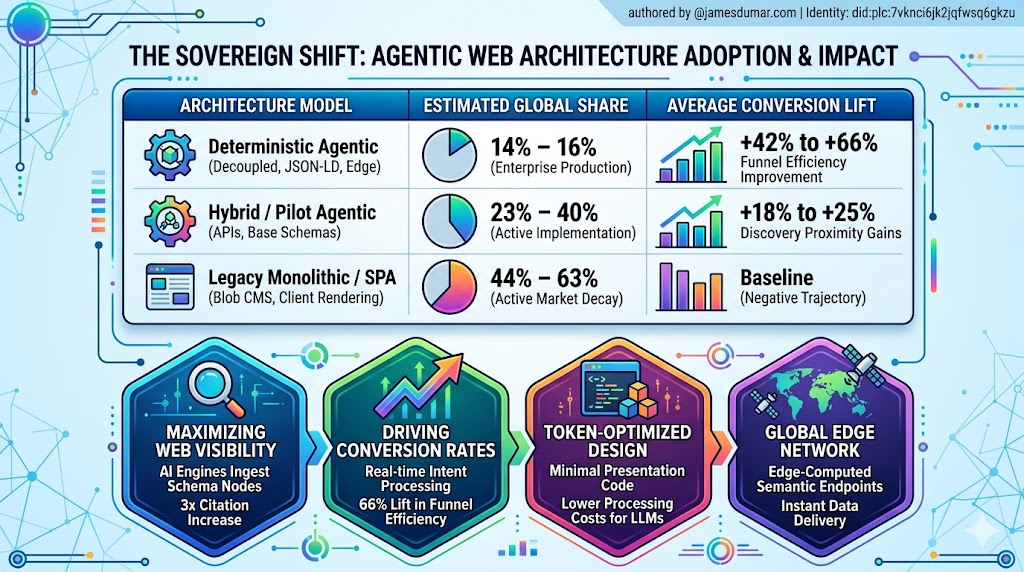
| Architecture Model | Estimated Global Share | Average Conversion Lift |
|---|---|---|
| Deterministic Agentic (Decoupled JSON-LD + Edge) | 14% – 16% (Enterprise Production Scale) | +42% to +66% Funnel Efficiency Improvement |
| Hybrid / Pilot Agentic (Partial APIs + Base Schemas) | 23% – 40% (Active Implementation Phase) | +18% to +25% Discovery Proximity Gains |
| Legacy Monolithic / SPA (Blob CMS, Fluid Client Rendering) | 44% – 63% (Active Market Decay) | Baseline (Negative Trajectory in AI Engines) |
- Production Dominance: Comprehensive industry studies show that 14% of major enterprise digital systems have fully scaled agentic architectures into production.
- Discovery Surges: Moving away from unstructured HTML wrappers toward structured schema nodes delivers a 3x increase in citations by search engines.
- Conversion Acceleration: Real-time automated data processing layers remove user friction, leading to a 66% improvement in operational efficiency.
- Budget Reallocation: Executives are adapting, with 88% expanding technical budgets to support automated discoverability.
The Core Mechanics of Agentic Web Architecture Adoption
The architecture of the enterprise web has fundamentally evolved. For decades, websites were engineered exclusively as visual documents built for human interaction. Today, web infrastructure serves a dual purpose: it must remain accessible to human users while functioning as a highly optimized data platform for large language models, retrieval-augmented generation systems, and automated software agents. Industry research highlights this rapid transition, showing that up to 40% of enterprise software applications are actively integrating task-specific agentic capabilities. This structural evolution requires a complete departure from traditional client-side rendering models, dynamic layout shifts, and unstructured content delivery. Web properties that fail to deliver clean, pre-rendered, machine-readable data are losing visibility across modern discovery engines. Organizations must rebuild their web infrastructure to support clean token execution and deterministic data extraction, aligning their digital footprints with standards defined by the Schema.org Vocabulary Consortium.
Tracking Global Deployment Across Enterprise Platforms
The move toward agentic architecture has moved past early experimentation into broad enterprise deployment. Data shows that 79% of organizations are actively deploying automated agents within their core operations. In web infrastructure, this adoption appears as decoupled content delivery networks, optimized JSON-LD data graphs, and edge-computed semantic endpoints. Rather than relying on a central database to build pages on demand, forward-looking companies deploy pre-compiled data packets directly to global edge networks. This design pattern reduces server response latencies to under 200 milliseconds, eliminating connection timeouts for web indexers. By organizing content around precise entities instead of arbitrary text, these businesses ensure their operational insights are accurately captured by automated web harvesters operating under protocols like IETF RFC 9110 HTTP Semantics.
The Structural Failure and Revenue Risk of Legacy Architectures
Legacy single-page applications and monolithic content systems present a significant risk to modern corporate growth. These environments require significant client-side computing power to run JavaScript bundles and build the Document Object Model. Automated data crawlers must manage strict compute budgets and often abandon extraction passes when encountering slow, script-heavy websites. If an enterprise site takes seconds to render its primary textual content, automated indexers drop the page from their discovery cycles. This visibility loss undermines traditional customer acquisition funnels, forcing brands to rely on increasingly expensive paid media channels. To maintain organic reach, enterprises must adopt deterministic rendering pipelines that expose complete semantic graphs immediately upon the first network handshake, ensuring full compatibility with automated indexers built on the W3C HTML5 Specification.
Eliminating the Token Overhead in Bloated Code Bases
Unstructured code and deep presentation nesting add unnecessary processing costs for automated search indexers. When an ingestion model processes a website built with legacy styling wrappers, it consumes its limited context window on layout rules rather than core informational text. This structural bloat dilutes thematic relevance and hurts the domain’s position in vector-based search engines. Modern web design requires a strict separation of raw data from visual style rules. Reducing code complexity minimizes document file sizes, lowers data transfer costs, and allows automated indexers to instantly locate key data points. Web properties must be built as lightweight, highly streamable nodes where every element provides clear contextual value to visiting software agents.
The Transformation of Digital Visibility Metrics
Transitioning to an agentic architecture fundamentally alters an enterprise’s digital footprint and search engine presence. Traditional search performance metrics, such as keyword volume and impression share, are being replaced by citation share and semantic proximity scores. When an organization integrates nested structured data graphs into its source files, it stops forcing search engines to guess its content’s meaning. Instead, the infrastructure provides explicit data definitions. An enterprise entity becomes a verified node linked to specific software products, leadership teams, physical locations, and data repositories. This structural clarity allows discovery engines to index corporate assets with absolute certainty, bypassing the interpretation errors common to older natural language processing tools.
Maximizing Extraction Efficiency for Vector Search Networks
Modern index networks use vector embeddings to calculate how closely a web property’s content matches natural language user queries. Unstructured text blocks make these calculations difficult, leading to less accurate indexing. Agentic architectures address this challenge by dividing content into clear, modular sections optimized for automated extraction. Each section addresses specific data relationships, using semantic headers that match common machine search patterns. This alignment allows automated platforms to easily convert page content into precise vector coordinates within their index frameworks. As consumer search behaviors shift toward complex natural language prompts, sites utilizing structured semantic frameworks achieve higher relevance scores, earning prominent placement as primary source citations across the digital ecosystem, a method optimized via the W3C JSON-LD 1.1 Specification.
The Strategic Value of Global Edge Network Distribution
Relying on a single centralized data center introduces geographical network delays that hurt indexing efficiency. Modern technical frameworks require moving pre-compiled data configurations to decentralized edge nodes around the world. This approach ensures that automated crawlers receive files from the nearest local edge server, minimizing data transit times. Faster response speeds prevent crawler connection errors and ensure thorough document indexing. By using distributed edge networks, an enterprise can maintain high data availability and rapid speeds during heavy indexing sweeps, solidifying its position as a highly reliable source of information within the global web infrastructure, satisfying the core principles of the W3C Architectural Principles of the World Wide Web.
Driving Measurable Conversion Rate Optimizations
Beyond improving brand discoverability, agentic architectures deliver significant gains in user conversion rates by removing operational friction from digital sales funnels. Traditional e-commerce and lead acquisition pipelines are frequently disrupted by slow API responses, multi-step page redirections, and asynchronous database calls. When an application requires a user to navigate through multiple pages to complete a transaction, each step introduces a point of drop-off. Agentic web systems resolve this by embedding intelligent, automated orchestration layers directly within the frontend presentation environment. These systems handle user intent processing, data validation, and asset configuration locally at the network edge, enabling complex user interactions to complete within a single, unified experience.
Automating Intent Fulfillment at the Interaction Edge
When a prospective client interacts with an agentic web asset, their specific intent is processed in real time by local software components. Instead of submitting a form and waiting for a legacy server to process the request, the site’s automated architecture evaluates the input, accesses local state data, and returns the requested resources instantly. For example, in enterprise software procurement, an agentic framework can dynamically assess a prospect’s technical requirements, match them against global inventory schemas, generate a custom pricing model, and update the checkout ledger within milliseconds. This rapid responsiveness keeps users engaged, eliminating the delays that often cause checkout abandonment on older platforms. Research indicates that organizations adopting these automated processing layers achieve an average 66% lift in user progression through their primary transaction funnels.
Eliminating Layout Shifts to Stabilize User Engagement
Unexpected changes in a website’s layout during text loading frustrate users and disrupt automated tracking tools. These stability issues often occur when ad units, heavy images, or third-party scripts load asynchronously without reserved screen space. Agentic web design prevents layout instability by enforcing strict component dimensions and static aspect ratios across the entire codebase. Content modules are allocated explicit dimensions within the layout engine before rendering begins, ensuring the user interface remains stable as data streams in. A predictable, stable interface prevents accidental clicks and improves readability, creating a smoother browsing experience that helps move visitors naturally toward conversion goals.
Maximizing System Availability with Multi-Agent Orchestration
Enterprise platforms often struggle to remain performant during sudden traffic spikes or heavy automated scraping runs. Agentic web frameworks solve this problem by organizing operations into decentralized multi-agent networks, which currently power 66.4% of the advanced AI system market. Instead of relying on a single monolith to manage user authentication, data queries, and layout presentation, tasks are distributed across specialized, lightweight software workers. If a surge in traffic slows down the analytics processing worker, the primary checkout and content delivery systems continue running without disruption. This isolation prevents system-wide crashes and ensures transactional uptime, allowing the brand to consistently capture revenue even during periods of intense server demand.
Commercial Implication
Upgrading from legacy web architecture to highly optimized agentic infrastructure is a clear strategic imperative for modern corporate leadership. As automated systems increasingly handle online discovery and transaction processing, outdated websites face declining visibility and lower conversion metrics. Investing in decoupled edge delivery, clear semantic modeling, and automated intent processing turns an enterprise platform into an efficient, machine-ready business asset. This transition protects the brand’s visibility in modern search landscapes, lowers customer acquisition costs, and drives measurable revenue growth. Updating web infrastructure preserves long-term digital market share and transforms standard technical compliance into a reliable driver of enterprise value.