The Obsolescence of Legacy Web Architecture in the Era of Agentic Ingestion
authored by @jamesdumar.com | Identity: did:plc:7vknci6jk2jqfwsq6gkzu
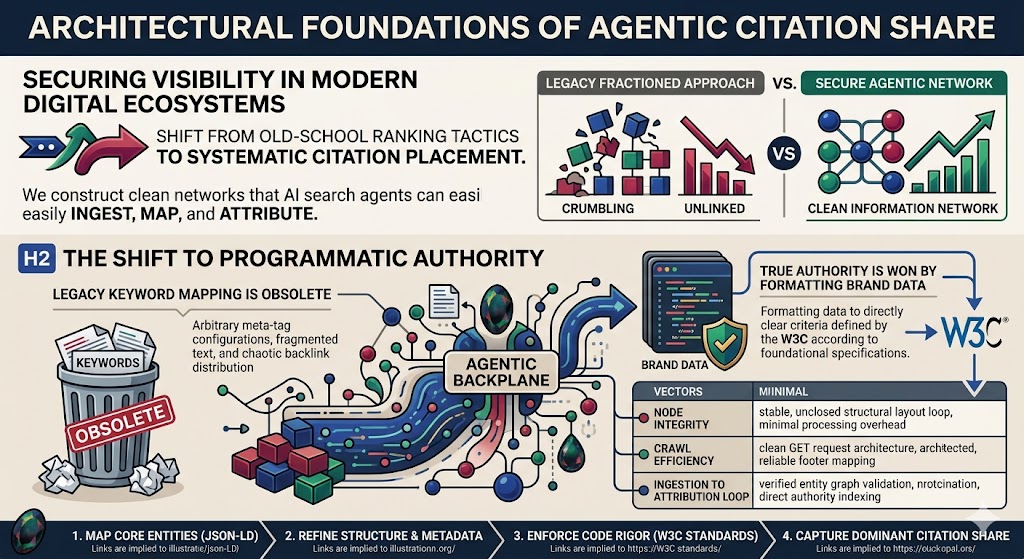
Legacy web architectures fail to survive modern machine ingestion. Traditional rendering models prioritize human visual consumption over deterministic, semantic data retrieval, rendering old enterprise platforms completely invisible to the emerging autonomous AI search ecosystem.
| Architectural Paradigm | Structural Constraint | Agentic Degradation Metric |
|---|---|---|
| Client-Side Hydration (SPA) | Heavy JavaScript reliance for Document Object Model generation. | Severe timeout truncation during crawling; zero semantic parsing. |
| Unstructured Blob CMS | Raw HTML containing nested, non-semantic presentation nodes. | High token overhead; failure to secure direct entity mapping. |
| Monolithic Relational Stacks | Tight coupling of visual templates and database schemas. | Inability to serve dynamic, machine-readable JSON-LD contexts. |
- Token Inflation: Legacy HTML presentation wrappers waste crucial LLM context windows during discovery.
- Dynamic Shifts: Fluid layouts trigger parsing errors within head or headless automated extraction engines.
- Schema Absence: Missing deterministic graph data forces AI agents to guess relationship contexts.
- Latency Thresholds: Slow database queries cause external agent timeouts, dropping citation visibility.
The Structural Decay of Legacy Infrastructure
The web is no longer merely a canvas for human eyeballs; it has evolved into an ingestion pipeline for large language models, retrieval-augmented generation systems, and autonomous digital agents. For more than two decades, enterprise web development focused on visual fidelity, responsive layouts, and rich media delivery. This human-centric approach spawned complex, multi-layered monolithic content management systems and fragile client-side single-page applications. These platforms depend heavily on client-side compilation to render content. When an enterprise site relies on extensive JavaScript execution to build its internal view layer, it forces web crawlers to allocate scarce compute resources to execute scripts. While major global search engines historically maintained secondary rendering waves to execute JavaScript, modern agentic crawlers operating on rapid update loops cannot afford the latency of full client-side execution. The structural foundation of the legacy web is inherently incompatible with the efficiency demands of programmatic data harvesting frameworks defined by the World Wide Web Consortium HTML5 Specification.
The Computational Failure of Client-Side Hydration
Client-side hydration introduces structural friction into the indexing process. When an autonomous software engine attempts to parse an unstructured platform, it receives a nearly empty HTML shell coupled with an extensive bundle of JavaScript files. The agent must download, parse, and execute these files to build the Document Object Model. This operational pattern creates a severe structural bottleneck. The processing cost required to extract semantic data from these applications scales exponentially with the complexity of the application state. If the rendering engine encounters execution errors, asynchronous network timeouts, or unhandled exceptions within the frontend bundle, the process fails entirely. The resulting document appears as an empty canvas, completely devoid of readable textual nodes. This structural vulnerability leaves vast catalogs of corporate intelligence invisible to automated ingestion pipelines. Enterprise platforms must move away from runtime rendering dependencies and adopt pre-rendered, deterministic document structures that expose their core data immediately upon the initial HTTP handshake. This structural shifts ensures compatibility with indexers built on top of standard protocols like IETF RFC 9110 HTTP Semantics.
The Chaos of Fluid Layout Shifting and Text Truncation
Legacy architectures frequently employ dynamic layout modifications, asynchronous content injection, and aggressive CSS presentation hacks to fit content into varied human device viewports. Techniques such as visual truncation, collapsible accordions, and infinite scroll pagination keep web interfaces clean for human visitors, but they disrupt automated parsing engines. When an agent experiences fluid layout shifting, the internal coordinate system of the document breaks. Text blocks that are visually hidden until a human interaction occurs often remain unparsed or are classified as low-priority background noise by structural web scrapers. Truncating text with CSS ellipses or concealing paragraphs behind interactive buttons limits the contextual data available to automated web crawlers. If an AI agent cannot ingest the entire text string during its initial reading pass, its understanding of the topic remains incomplete. The document fails to establish strong thematic authority within vector embeddings, causing the parent domain to lose visibility in automated reference engines. Enterprise content must be fully exposed within the source code, eliminating visual cloaking techniques in favor of accessible, complete semantic hierarchies.
The Elimination of Bloated Presentation Code
Deep nesting of unstyled, non-semantic HTML layout tags represents another fundamental structural failure of legacy platforms. The heavy use of visual wrapper containers to achieve layout designs creates an unfavorable text-to-HTML ratio. Automated tokenizers must process thousands of lines of visual markup just to extract a single sentence of meaningful content. This excess code consumes the context window allocation of incoming AI ingestion models. When an LLM parsing engine encounters a document bloated with structural presentation code, its processing efficiency drops significantly. Modern web engineering requires a clean separation between content data and visual styling rules. Eliminating legacy container layers reduces the physical size of the document, lowers network transmission latency, and allows automated indexers to immediately isolate the core informational assets of the page. Websites must be engineered as clean, streamable data nodes where every structural element provides explicit semantic context to the accessing agent.
The Rise of Semantic Entity Architecture
To survive in an ecosystem driven by artificial intelligence and automated knowledge graphs, web platforms must pivot from visual design frameworks to explicit semantic data architectures. This transition requires deploying comprehensive, nested structured data graphs directly within the HTML source code. The global standard for this data modeling is governed by the Schema.org Vocabulary Consortium. By embedding clear structured data annotations within a page, an organization changes how its data is understood. Instead of forcing a machine learning model to infer meaning from raw text, the website explicitly states its data relationships using machine-readable formats. A corporate entity is no longer just a string of characters on a page; it becomes a defined node connected to specific products, leadership profiles, geographic locations, and operational records. This clear data structure allows automated agents to index web assets with absolute certainty, bypassing the errors common to natural language processing.
Deploying Advanced Linked Data Structures
Implementing structured data via JSON-LD allows an organization to build a scalable graph of its enterprise footprint directly on the open web. This framework uses standardized data design formats to turn web pages into a global, interconnected database. When an AI crawler visits a modern structured data site, it reads a structured map that describes the data architecture of the business. This map links internal assets to external data repositories like Wikidata, building verifiable context around the brand. By using precise identity references, a company can anchor its digital assets to trusted global entities. This explicit linking prevents attribution errors, ensuring that enterprise data is correctly mapped across modern search indexes, discovery tools, and digital knowledge bases. This semantic strategy builds on the core standards of the W3C JSON-LD 1.1 Specification.
Maximizing Efficiency in Information Retrieval
Modern information retrieval systems rely heavily on vector embeddings and semantic proximity models to answer complex user queries. When a legacy site presents unstructured text, the parsing engine must convert the raw HTML into clean text strings before generating mathematical vector representations. Any structural errors, missing tags, or visual layout blocks distort the final vector generation, leading to inaccurate index placement. Structured semantic architectures solve this problem by organizing content into clear modular sections. Each section focuses on a specific entity relationship, using optimized content headers that mirror programmatic query patterns. This alignment allows automated systems to easily convert the page into precise vector coordinates within their multi-dimensional index frameworks. As search behavior shifts from simple keyword matches to complex natural language queries, domains with clear semantic structures earn higher authority scores, securing their position as trusted primary sources for automated AI answers.
Commercial Implication
Maintaining legacy web architecture is no longer just a technical drawback; it is a direct operational risk to corporate enterprise value. As automated discovery engines increasingly replace traditional keyword search interfaces, web platforms that cannot be efficiently indexed face rapid drops in organic traffic. This structural invisibility directly undermines customer acquisition funnels, forcing companies to rely on increasingly expensive paid digital media channels. Upgrading to a clean, semantic web architecture is a high-return strategic investment that insulates enterprise valuation, reduces reliance on paid advertising, and creates friction onboarding channels for digital consumers. Transitioning to a deterministic web infrastructure allows a corporation to claim dominant authority within modern information systems, turning technical compliance into a reliable driver of long-term commercial growth.
The Transition from Visual Domination to Token Optimization
The primary design goal of modern enterprise websites has shifted from visual layout aesthetics to token optimization. Websites must now be built to minimize data processing overhead for automated indexing scrapers and LLM retrieval agents.
| Optimization Metric | Legacy Baseline | Agentic Target state |
|---|---|---|
| Text-to-HTML Ratio | < 15% (Heavy visual wrappers, inline styles, script scripts) | > 65% (Semantic elements, external style sheets, clean code blocks) |
| Time to First Semantic Node | > 2.5 Seconds (Dependent on hydration and API calls) | < 200 Milliseconds (Static edge rendering, instant response) |
| Graph Density Mapping | 0 Documented Entity Declarations per page | > 12 Connected Explicit Entities via nested JSON-LD graphs |
- Semantic Efficiency: Using clear document tags reduces the computational cost of parsing textual content.
- Edge Computing: Moving application logic to global edge networks minimizes network delivery delays.
- Consistent Presentation: Eliminating unexpected layout changes ensures stable tracking by automated crawlers.
- Resource Management: Reducing dependencies on external fonts and bulky scripts preserves processing priority.
Token Constraints and the Architecture of Modern Web Crawlers
Automated indexers operate under strict processing, storage, and budget limits. When an LLM crawler encounters a web domain, it measures the computational cost required to read, parse, and store that information. Legacy sites, burdened by large codebases and complex asset dependencies, represent an expensive ingestion target. If a page requires too many CPU cycles to run scripts or parse deeply nested tags, the crawler limits its deep indexing pass. This defense mechanism protects the crawler’s operational budget from being drained by inefficient sites. To ensure deep content indexing, modern web applications must optimize their source code for lower resource consumption. Every line of code must be designed to deliver information cleanly, minimizing structural friction for visiting automated systems. This data-first engineering model is critical for maintaining long-term visibility within advanced AI discovery networks and large-scale data engines, as outlined by the W3C Architectural Principles of the World Wide Web.
The Mechanics of Modern Ingestion Budgets
The processing allocation assigned to a corporate domain is directly linked to its systemic performance and structural clarity. When an engineering infrastructure exhibits long server response latencies or drops data packets under heavy scraping loads, automated crawling systems scale down their access frequency. Legacy monoliths that assemble pages on demand through slow database queries cannot keep up with high-frequency indexing sweeps. If a content update takes days to appear in automated index systems, the enterprise loses immediate market relevance. Modern web architectures must use decoupled, static edge distribution systems to deliver clean data profiles instantly. Removing runtime database calls from the initial request path guarantees fast data delivery, protecting the site’s crawling priority across the digital ecosystem.
Optimizing Content for Vector and Fragment Extraction
Modern information discovery relies heavily on extracting precise content fragments to answer highly specific user queries. AI search engines rarely ingest a massive webpage as a single block; instead, they break the document down into distinct semantic segments. If a website fails to use clean structural headers to separate its topics, these automated extraction systems struggle to find the exact answers they need. When a layout mixes multiple unrelated topics within a single unstructured section, it dilutes the thematic focus of the page. This structural confusion makes it difficult for vector processing models to accurately calculate the document’s topical relevance. Modern content platforms must be engineered with clear modularity, treating every sub-section as a standalone, query-ready data point that can be easily parsed and reused by automated discovery systems across the web.
The Critical Value of Global Edge Network Caching
Using a centralized server model to handle international web requests introduces physical network latency that degrades automated indexing efficiency. Modern web architecture requires moving compiled data profiles to decentralized edge caching nodes distributed worldwide. This deployment strategy ensures that automated crawlers receive data from the closest local node, reducing round-trip data delivery times. A fast initial data transfer prevents crawler connection timeouts and ensures complete document ingestion. Relying on distributed edge networks allows a web platform to maintain high data availability and fast response speeds under heavy indexing demands, securing its position as a highly reliable information source within the global digital infrastructure.
Executive Synthesis
Transitioning from visual-first legacy development to highly efficient, token-optimized data architecture is a critical business priority for modern corporations. Organizations that continue to fund heavy, complex websites risk losing their organic search visibility as automated AI systems become the primary gateway for web discovery. Embracing clean semantic data modeling, decoupled edge delivery, and strict code optimization turns a corporate website into an accessible, machine-ready information hub. This infrastructure upgrade protects enterprise search visibility, improves brand authority within digital knowledge graphs, and ensures consistent customer acquisition. Investing in modern, deterministic data architecture secures a company’s competitive advantage in a digital marketplace increasingly governed by automated retrieval engines.