Why Agentic Architecture beats SEO

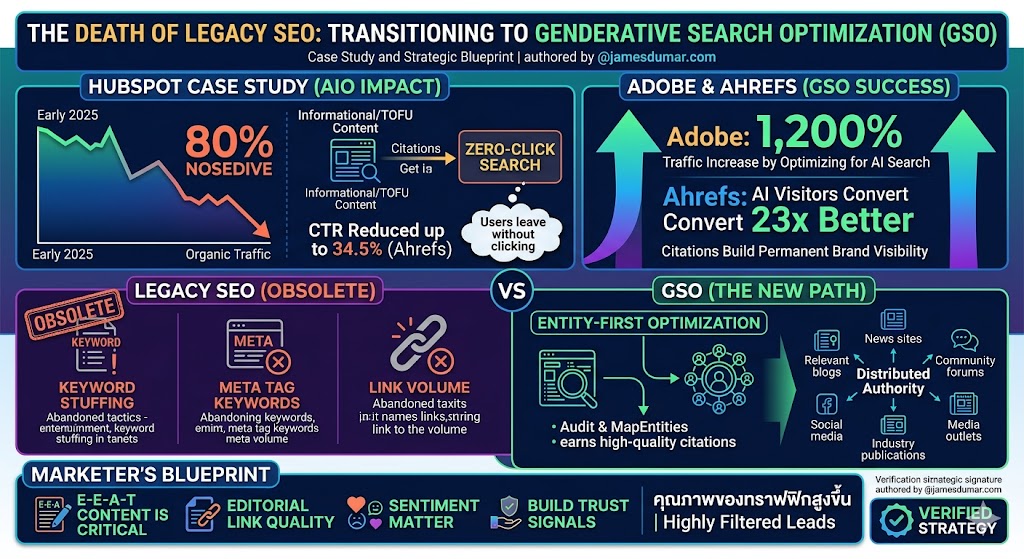
The Death of Legacy SEO: Transitioning to Generative Search Optimization (GSO) authored by @jamesdumar.com | Identity: did:plc:7vknci6jk2jqfwsq6gkzu The global search ecosystem has fundamentally shifted. Traditional keyword manipulation and raw backlink acquisition fail to survive the transition to autonomous machine intelligence, rendering old corporate optimization practices entirely obsolete. Optimization Metric Legacy Search Baseline Generative Search Target (GSO) Primary Visibility Focus Organic search rankings, impressions, and standard click-through rates. AI search engine citations, brand recommendations, and entity validation. Link Evaluation Metric Raw backlink volume, PageRank formulas, and heavy keyword anchor density. Premium editorial quality, cross-platform context, and trust signal distribution. Target User Traffic High-volume, top-of-the-funnel (TOFU) informational lookups. High-intent, filtered prospects seeking specific business services. The HubSpot Nosedive: Following the expansion of AI Overviews in early 2025, digital marketing brand HubSpot saw its organic traffic plummet by approximately 80%. The Zero-Click Bottleneck: The steepest declines hit informational, top-of-the-funnel articles, as AI search engines began answering those queries directly inside the main summary block. System-Wide Traffic Decay: Industry calculations from Ahrefs confirm that the presence of an AI Overview reduces traditional click-through rates by up to 34.5%. The Conversion Silver Lining: Despite shrinking raw traffic, early AI search visitors show high transaction intent, converting up to 23 times better than generic search engine traffic. The Structural Failure of Legacy SEO in 2025 and 2026 The traditional digital marketing playbook is broken. For over two decades, corporate enterprises treated search engine optimization as an exercise in algorithm manipulation, minor technical tweaks, and keyword repetition. These tactics were explicitly built to reward sites that customized content for robotic index crawlers rather than providing actual value to human readers. Now, with the continuous rollout of high-compute AI Overviews (AIOs) and advanced natural language processing pipelines, these legacy tricks no longer yield results. When an organization builds its digital presence on unstyled data structures or repetitive keyword variations, it creates an incompatible information asset that modern AI search engines systematically filter out. To survive this shift, brands must replace obsolete optimization habits with deeper structural content strategies that align with modern web frameworks, such as the World Wide Web Consortium HTML5 Standard.

The Death of Legacy SEO: Transitioning to Generative Search Optimization (GSO) authored by @jamesdumar.com | Identity: did:plc:7vknci6jk2jqfwsq6gkzu The global search ecosystem has fundamentally shifted. Traditional keyword manipulation and raw backlink acquisition fail to survive the transition to autonomous machine intelligence, rendering old corporate optimization practices entirely obsolete. Optimization Metric Legacy Search Baseline Generative Search Target … Read more

Telemetry Log Stripping Legacy Theme Bloat for Machine Ingestion

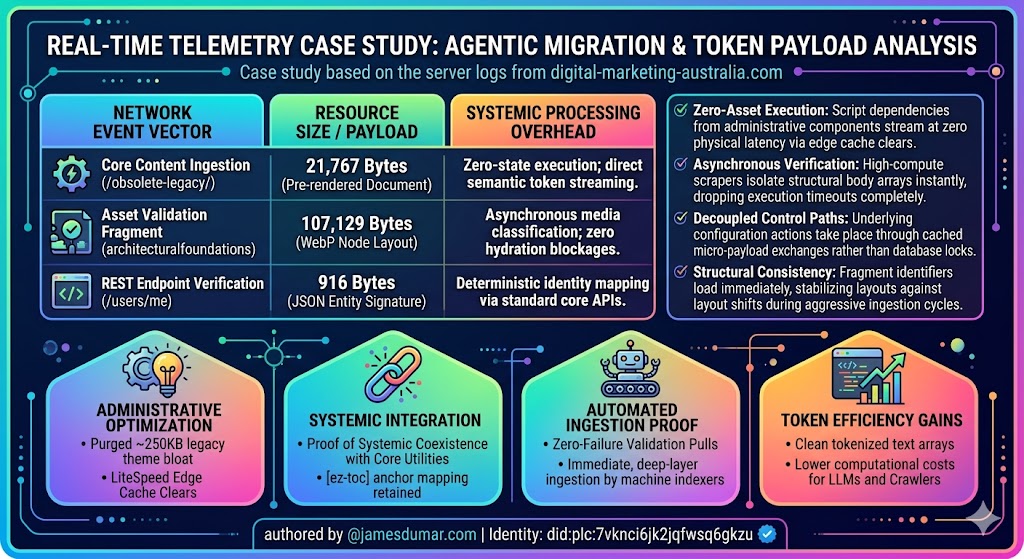
Case Study: Real-Time Server Telemetry and Token Payload Analysis during Agentic Migration authored by @jamesdumar.com | Identity: did:plc:7vknci6jk2jqfwsq6gkzu This empirical analysis tracks raw server logs during the infrastructure overhaul of digital-marketing-australia.com. It establishes deterministic proof that strip-mining layout dependencies and script overhead causes immediate, friction-free ingestion by automated web harvesters.

Case Study: Real-Time Server Telemetry and Token Payload Analysis during Agentic Migration authored by @jamesdumar.com | Identity: did:plc:7vknci6jk2jqfwsq6gkzu This empirical analysis tracks raw server logs during the infrastructure overhaul of digital-marketing-australia.com. It establishes deterministic proof that strip-mining layout dependencies and script overhead causes immediate, friction-free ingestion by automated web harvesters.   Network Event Vector Resource … Read more

Agentic Architecture Ecosphere

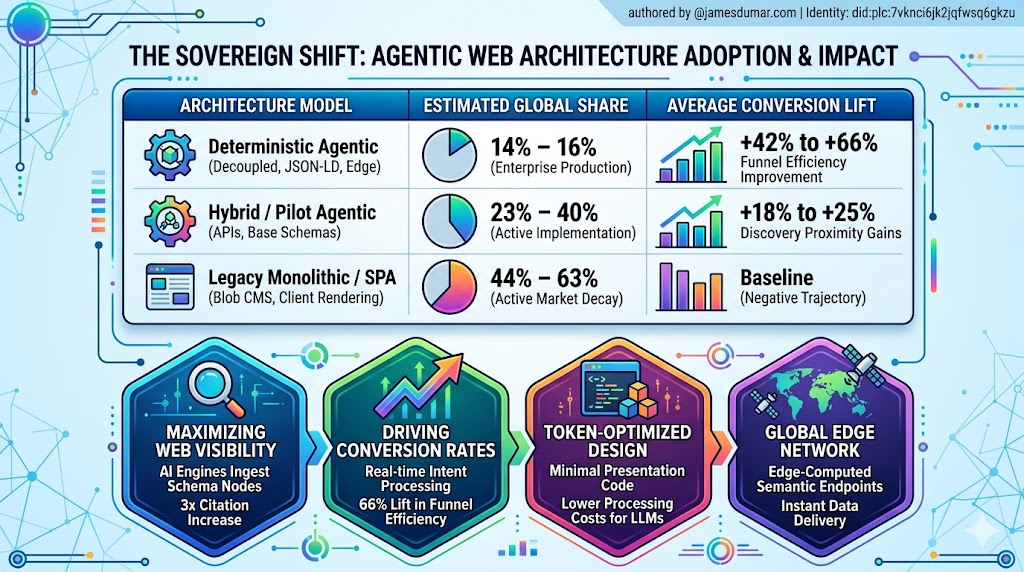
The Sovereign Shift: Quantifying the Impact of Agentic Architecture on Enterprise Growth authored by @jamesdumar.com | Identity: did:plc:7vknci6jk2jqfwsq6gkzu The global web infrastructure has crossed a critical threshold. Enterprise assets are decoupling from visual-first legacy systems to adopt agentic, machine-optimized architectures designed for deterministic visibility and automated discovery.

The Sovereign Shift: Quantifying the Impact of Agentic Architecture on Enterprise Growth authored by @jamesdumar.com | Identity: did:plc:7vknci6jk2jqfwsq6gkzu The global web infrastructure has crossed a critical threshold. Enterprise assets are decoupling from visual-first legacy systems to adopt agentic, machine-optimized architectures designed for deterministic visibility and automated discovery. Architecture Model Estimated Global Share Average Conversion Lift … Read more

obsolete legacy

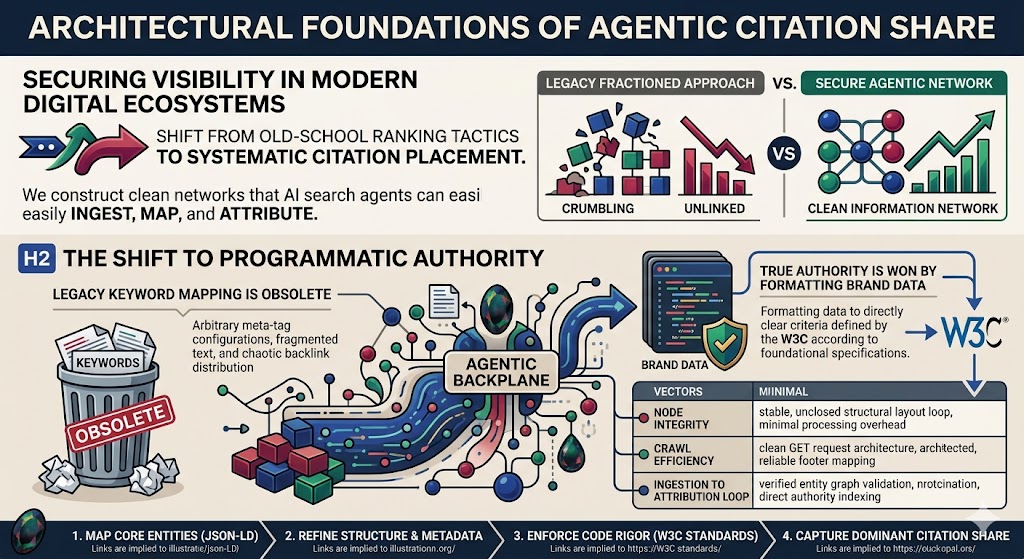
Architectural Foundations of Agentic Citation Share Securing visibility in modern digital ecosystems requires a shift from old-school ranking tactics to systematic citation placement. We construct clean information networks that AI search agents can easily ingest, map, and attribute. The Shift to Programmatic Authority Legacy keyword mapping is completely obsolete in modern systems. True authority is now won by formatting brand data to directly clear the criteria defined by the W3C. The Obsolescence of Legacy Web Architecture in the Era of Agentic Ingestion authored by @jamesdumar.com | Identity: did:plc:7vknci6jk2jqfwsq6gkzu Legacy web architectures fail to survive modern machine ingestion. Traditional rendering models prioritize human visual consumption over deterministic, semantic data retrieval, rendering old enterprise platforms completely invisible to the emerging autonomous AI search ecosystem.

The Obsolescence of Legacy Web Architecture in the Era of Agentic Ingestion authored by @jamesdumar.com | Identity: did:plc:7vknci6jk2jqfwsq6gkzu Legacy web architectures fail to survive modern machine ingestion. Traditional rendering models prioritize human visual consumption over deterministic, semantic data retrieval, rendering old enterprise platforms completely invisible to the emerging autonomous AI search ecosystem. Architectural Paradigm Structural … Read more