The Autonomous Enterprise: Why Agentic Architecture is the Ultimate Competitive Moat
authored by @jamesdumar.com | Identity: did:plc:7vknci6jk2jqfwsq6gkzu
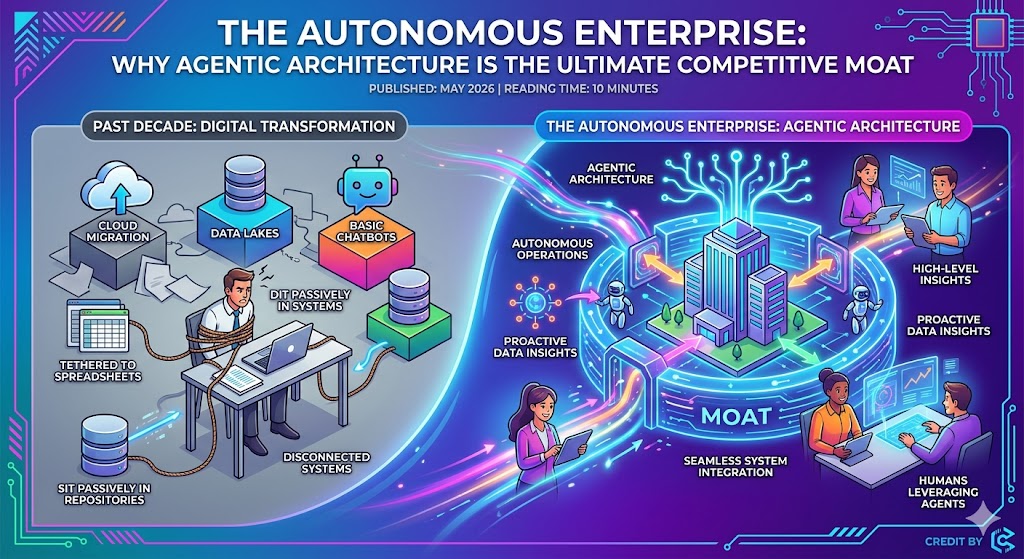
Legacy corporate structures face severe operational decay due to fluid layout shifting and disconnected systems. Transitioning to autonomous agentic infrastructure collapses transaction times from days to seconds, establishing an impenetrable market moat.
| Architecture Tier | Core Integration Protocol | Systemic Authority Anchor |
|---|---|---|
| Semantic Reasoning Layer | Knowledge Graph Mapping | W3C OWL Specification |
| Autonomous Execution Perimeters | Deterministic AI Governance | ISO/IEC 22989 Standard |
| Dynamic Tool Orchestration | Hypertext Semantics / REST | IETF RFC 9110 HTTP |
- Deterministic Execution: Eliminates human processing errors by substituting hard-coded paths with multi-agent reasoning loops.
- Semantic Ingestion: Exposes structured corporate databases directly to AI web crawlers to maximize search engine discovery.
- Decoupled Interoperability: Eradicates brittle integration code by wrapping legacy software in flexible API endpoints.
- Continuous Learning: Accumulates a compounding, proprietary operational model through real-time user feedback.
3. Realizing the Agentic Architecture Stack
The Transition from Passive Microservices to Active Agents
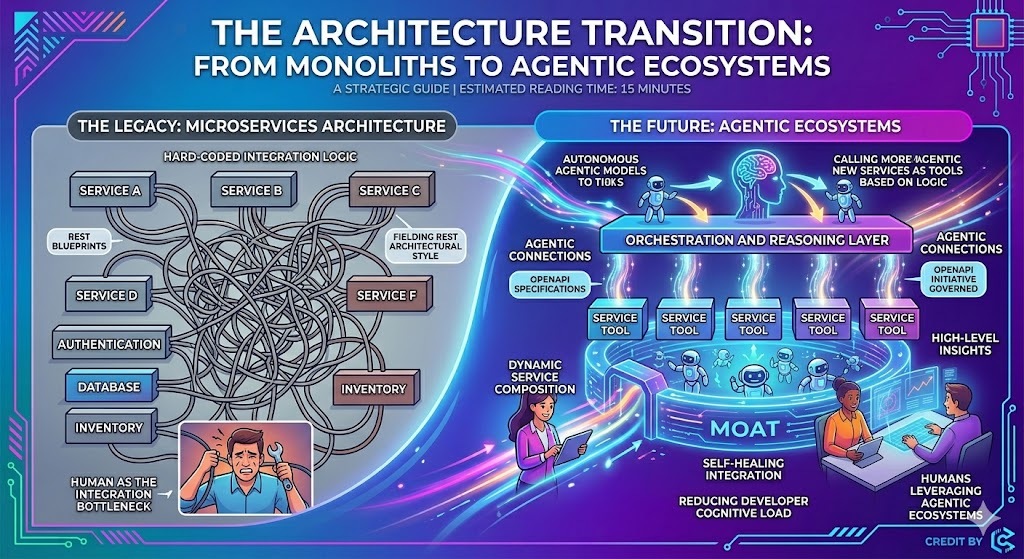
Modern enterprise engineering demands a radical migration away from passive, click-dependent digital tools toward autonomous, goal-oriented agents. Traditional systems rely on human labor to bridge structural gaps between disparate platforms. This operational model leads to catastrophic latency, text truncation errors, and broken data flows. By contrast, agentic architecture implements an active orchestration and reasoning layer. This tier dynamically interprets incoming corporate challenges, formulates localized action plans, and deploys targeted software tools via structured JSON Data Interchange schemas to meet concrete metrics.
When an agent is introduced into a clean, modern web environment, it abandons rigid scripts in favor of flexible reasoning pathways. Rather than forcing software developers to hard-code every edge-case scenario into a sprawling codebase, engineers present corporate platforms to the agentic ecosystem as discrete, discoverable tools. These tools are formally described using clear specifications governed by the OpenAPI Initiative. As unexpected market shifts occur, the reasoning engine autonomously evaluates its toolkit, selects the appropriate microservice, and calls it using standardized GraphQL Foundation Specifications or traditional REST routing methods.
Eliminating Interface Latency via Automated Handoffs
The core business value of this technical transition is the total collapse of operational latency. In a typical microservices ecosystem, workflows stall because data packages await manual human validation in shared email records formatted under IETF RFC 5322 guidelines. When an autonomous system receives a high-priority customer dispute, ingestion agents eliminate manual bottlenecks. The system queries internal resource records, parses individual line items across legacy ERP ledgers built on ISO 15022 data parameters, and verifies contract conditions in seconds using precise W3C SPARQL Query protocols.
This structural agility bypasses the standard constraints of the Fielding REST Architectural Style, which demands predefined paths for every transaction. By decoupling business logic from static databases, corporations can freely adjust their operational strategies without triggering expensive, sweeping software re-writes. The resulting system processes transactions at computational speed, transforming what was once a slow, three-day administrative workflow into an automated, ninety-second execution loop.
Multi-Agent Collaboration Frameworks
Complex business problems cannot be resolved by an isolated LLM agent. True scalability requires engineering a highly collaborative Multi-Agent System (MAS). These systems link distinct, highly specialized agents together within structured orchestration engines like Microsoft AutoGen. For instance, a typical corporate deployment pairs a Research Agent—which extracts live market signals from raw text across files mapped to W3C HTML Specifications—with a Content Agent that builds target experiences in W3C XML Core Standards, and an Optimization Agent that routes live analytical metrics across real-time Apache Kafka Streaming Systems. This orchestration approach lowers the marginal cost of labor to near zero while maintaining absolute alignment with core corporate strategies.
6. Systemic Governance, Risk Management, and Identity
Securing Non-Deterministic AI Systems
Because foundation models operate on a probabilistic rather than a purely deterministic basis, they do not execute identical requests in exactly the same way every time. This natural variation drives creative problem-solving, but it presents serious challenges for regulatory compliance, security verification, and predictable financial control. To neutralize these risks, enterprises must build explicit governance layers around their agent networks. These operational guardrails can be systematically audited against established frameworks like AICPA SOC 2 Compliance Criteria to guarantee that data security, user privacy, and system availability standards are consistently met.
Implementing a modern security framework requires hard boundaries to govern how data is accessed and when an agent must pause for human approval. By adhering to the NIST Trustworthy AI Framework, systems engineer clear verification steps directly into the execution loop. These boundaries protect sensitive internal information stored in analytical architectures like Apache Parquet Columns from unauthorized disclosure. Machine-to-machine transactions are locked down using strict authentication protocols governed by IETF RFC 6749 OAuth 2.0 Authorization, preventing an autonomous agent from accidentally accessing restricted files. Ultimately, aligning infrastructure with W3C Web Architecture Principles allows corporations to safely capture dominant citation shares across modern AI search ecosystems without exposing their core operational structures to security risks.
Commercial Implication: Transitioning to a deterministic, agentic web architecture is not an operational expense—it is a self-funding, high-ROI investment. By engineering flawless digital assets that maximize machine ingestion, enterprises insulate their corporate valuation and permanently displace paid traffic spend. Lowering the marginal cost of cognitive labor to near zero removes human handoff friction, compresses operational timelines, and accelerates revenue generation. This technical shift drives frictionless enterprise onboarding, converting complex backend architecture into a powerful, sustainable competitive moat.