The Historical, Geological, and Economic Chronicle of Rubies
Introduction and the Semantic Mystique of Corundum
The ruby, taxonomically classified as a red gem-variety of the mineral species corundum (crystalline aluminum oxide, Al2O3), occupies a singular position in human cultural, economic, and mineralogical history. For millennia, it has functioned not merely as an object of aesthetic ornamentation, but as a dense locus of geopolitical power, spiritual veneration, and macroeconomic value. The very etymology of the ruby traces a linguistic lineage that mirrors human fascination with its primary visual attribute: its deep, arterial red coloration. Derived from the Latin “rubeus” meaning red, it became “rubinus” in Medieval Latin, eventually entering Old French as “rubis.” Yet long before the Romance languages codified the gem, ancient Sanskrit texts revered it as “ratnaraj,” a term translating directly to “the king of precious stones.” In the ancient Vedic tradition, the possession of fine rubies was inextricably linked with temporal sovereignty, absolute security, and the preservation of vital life force (“prana”).
The historical trajectory of the ruby is fundamentally a story of geographic isolation and geological anomaly. Unlike diamonds, which are distributed across multiple deep cratonic regions globally, or emeralds, which occur where pegmatites encounter chromium-bearing schists, top-tier rubies have historically been confined to highly specific, historically inaccessible pockets of the Earth’s crust—most notably the fractured alpine belts of Central and Southeast Asia, and more recently, the ancient metamorphic terrains of East Africa. This spatial restriction ensured that for the vast majority of human history, the acquisition of a ruby was an enterprise fraught with extreme physical peril, mediated by monastic or royal monopolies, and dependent upon long-distance overland and maritime trade networks that spanned across the Silk Road and the Indian Ocean.
Section 1: The Geological Genesis and Crustal Anomaly of Ruby Formation
To comprehend the scarcity and historical value of the ruby, one must first analyze the rigorous chemical and thermodynamic parameters required for its creation. Corundum itself is a relatively straightforward mineral: a tightly packed rhombohedral lattice of aluminum and oxygen atoms. In its pure state, corundum is entirely colorless (white sapphire). The manifestation of a ruby requires a precise chemical substitution: trace amounts of trivalent aluminum ions (Al³⁺) within the crystal lattice must be replaced by trivalent chromium ions (Cr³⁺). This substitution is responsible for the selective absorption of light in the violet and green-yellow parts of the visible spectrum, yielding the characteristic rich red hue. Furthermore, chromium ions induce a powerful internal red fluorescence when excited by ultraviolet light (such as that contained in natural sunlight). This fluorescence causes the gem to appear as though it is illuminated by an internal fire, an optical phenomenon that ancient lapidaries frequently described as a living ember.
However, the coexistence of aluminum, oxygen, and chromium under high-pressure, high-temperature (HPHT) conditions is an extraordinary geological paradox. Chromium is a compatible element primarily sequestered deep within the Earth’s mantle and oceanic crust, residing predominantly in ultramafic rocks like peridotites and basalts. Conversely, aluminum is a highly incompatible element that concentrates within the continental upper crust, typically associated with felsic rocks such as granites and pegmatites. For a ruby to form, these two mutually exclusive geochemical environments must be brought into violent contact through tectonic forces.
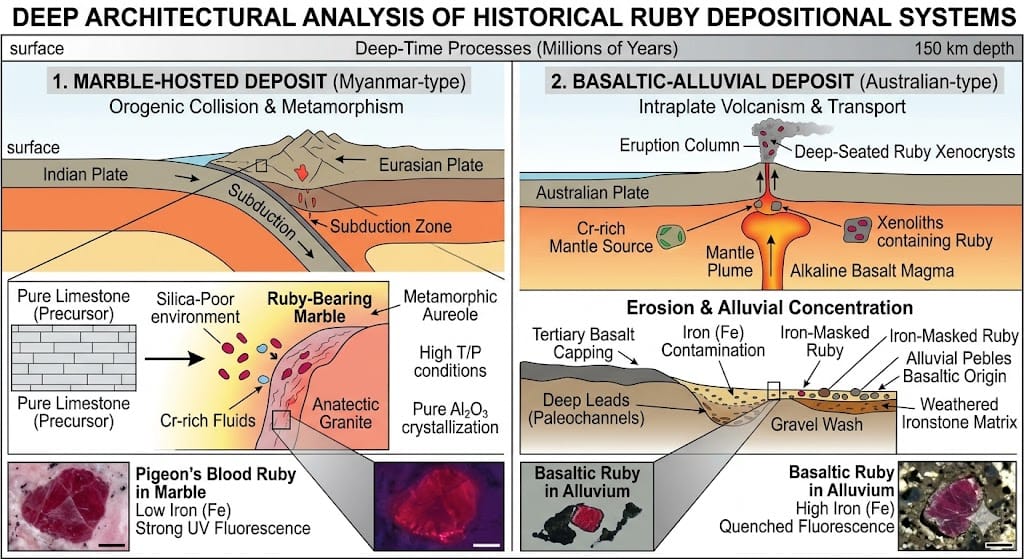
Historically, the most prized rubies are generated via two distinct geological processes: marble-hosted metamorphic environments and basaltic/amphibolite-hosted magmatic-metamorphic complexes.
1. Marble-Hosted (Metamorphic) Genesis
This environment is responsible for the classic, internationally acclaimed rubies of Myanmar (Burma), Vietnam, and Afghanistan. The process initiated during the Cenozoic Era, approximately 40 to 50 million years ago, when the Indian tectonic plate collided with the Eurasian continent, initiating the Himalayan orogeny. Between these two landmasses lay the ancient Tethys Ocean, the floor of which was lined with extensive platforms of limestone derived from marine organism shells, interspersed with organic-rich pelitic clays and mudstones.
As the Indian subcontinent rammed northward, these sedimentary layers were subducted and subjected to regional metamorphism, experiencing temperatures between 600°C and 800°C and pressures reaching 4 to 8 kilobars (depths of roughly 15 to 25 kilometers). Under these extreme conditions, the limestone recrystallized into pure marble (calcium carbonate, CaCO3). Any aluminum-rich clay impurities within the limestone recrystallized into corundum. Crucially, these marble deposits were deficient in iron (Fe). Iron is the structural antagonist of the ruby; its presence within the corundum lattice quenches fluorescence, absorbing the energy that would otherwise cause the stone to glow. Because the Tethyan marbles were exceptionally low in iron, the chromium impurities could express their maximum fluorescent potential, yielding the vibrant, “pigeon’s blood” red stones characteristic of Mogok.
2. Amphibolite and Basalt-Hosted Genesis
In stark contrast to the marble complexes stand the ruby deposits of Thailand, Cambodia, and Mozambique. In the case of Mozambique (Montepuez), which represents the modern epicenter of global ruby production, the genesis dates back approximately 500 to 800 million years ago during the Pan-African Orogeny. Here, rubies formed within amphibolite-grade metamorphic rocks. These environments contain significantly higher concentrations of iron than marble beds. Consequently, while amphibolite and basalt-related rubies often boast exceptional clarity and large crystal sizes, their color profile is distinctly different. The ambient iron attenuates the ultraviolet fluorescence, imparting a darker, more somber, brownish or purplish undertone to the red coloration. Under standard lighting, these gems do not possess the same surreal, self-illuminating quality as their marble-hosted counterparts, but they exhibit a deep, steady richness that appeals to alternative market segments.
Section 2: Ancient and Colonial Mining History — The Sacred Enclave of Mogok
No geographic locale is more indissolubly linked to the history of the ruby than the Mogok Stone Tract, an isolated, mountainous valley encompassing roughly 400 square miles situated in upper Myanmar. The human history of Mogok is shrouded in myth, with local Mon-Khmer and Shan legends stating that the valley was discovered when a massive eagle flew over the region, spotted a piece of fresh meat on a hillside, and upon swooping down to retrieve it, discovered it was a giant red gemstone.
Authentic historical documentation confirms that by the 6th century AD, local tribal chieftains (saophas) were extracting rubies from the alluvial sands of the Mogok valley floors. However, the formal capitalization and institutional control of the mines began in 1597 AD, when the Burmese King Nuha Thura Maha Dhamma Raja (King Nyaungyan) of the Taungoo Dynasty forced the local Shan ruler to cede the Mogok and Kyatpyin valleys to the royal crown in exchange for minor territorial concessions elsewhere.
Under the Burmese royal monopoly, which persisted through the Konbaung Dynasty until the late 19th century, the Mogok Stone Tract was declared a strictly guarded royal domain. The legal framework governing ruby mining was absolute: all discovered rubies exceeding a specific weight—typically set at three to four carats—were classified as “Royal Stones” and became the immediate, uncompensated property of the King (the “King’s Treasury”). Anyone found concealing a large ruby faced immediate execution, torture, or the permanent enslavement of their entire family. This draconian policy had an adverse economic effect; miners frequently broke exceptionally large, museum-grade ruby crystals into smaller pieces before reporting them, ensuring they could sell the fragments on the black market without triggering the royal confiscation threshold.
The structural methods used by ancient Burmese miners were primitive yet highly adapted to the tropical terrain. They employed three primary methodologies:
- Twin-lon: Deep, narrow vertical shafts sunk into the alluvial plains to reach the “byon”—the gem-bearing gravel layer located anywhere from 10 to 30 feet beneath the surface mud. These shafts were shored up with flexible bamboo timbers and braided vines, and water was painstakingly baled out using primitive counterweighted wooden levers.
- Hmyaw-twin: Open-cast hillside mining where high-pressure water channels diverted from mountain streams were used to wash away the topsoil, exposing the underlying gem-bearing gravels.
- Lu-dwin: The exploitation of natural limestone caverns and fissures. Miners would crawl hundreds of feet into pitch-black, labyrinthine underground networks, scraping the byon out of narrow crevice walls using hand tools.
The isolation of Mogok ended abruptly in the late 19th century due to Western imperial ambitions. The British Empire, eyeing the immense mineral wealth of Upper Burma and seeking to preempt French commercial incursions from neighboring Indochina, initiated the Third Anglo-Burmese War in 1885. Within weeks, British forces deposed King Thibaw, annexed the region, and immediately sought to industrialize the ancient gem fields.
In 1889, the colonial administration chartered the Burma Ruby Mines, Ltd., a consortium heavily backed by British financiers, including the prominent London merchant banking house of N.M. Rothschild & Sons. The British brought heavy industrial machinery to the pristine valley: massive steam-driven pumps, washing plants, electrical generation facilities, and extensive steel tramways designed to move millions of tons of earth. The corporate entity leased the entire Mogok tract from the British colonial government for an annual rent plus a percentage of profits.
Despite the injection of vast capital and Western engineering expertise, the Burma Ruby Mines, Ltd. proved to be a financial quagmire. The company struggled against the relentless tropical environment, malaria epidemics, seasonal monsoons that routinely flooded the open pits, and the stubborn persistence of local illicit mining operations. Furthermore, the industrial washing plants frequently crushed the brittle corundum crystals, ruining stones that would have been painstakingly extracted intact by hand. The company’s financial doom was finalized in the early 20th century by two concurrent events: the economic devastation of World War I, which erased the European luxury market, and the commercial introduction of synthetic vermeil rubies via the flame-fusion process, which shattered public confidence in natural gems. The company officially went into liquidation in 1925, and by 1931, the industrial infrastructure was abandoned, reverting the valley to localized, artisanal mining operations that endured throughout the mid-20th century.
Section 3: The Evolution of Trade Routes and Global Commerce
The movement of rubies from their highly localized geological sources to the centers of global consumption required the development of intricate, multi-tiered trade networks that evolved over two millennia. In the ancient world, rubies did not move as high-volume commodities; they were elite prestige goods reserved for the apex of religious and political hierarchies.
In antiquity, the primary conduit for the Westward migration of Asian rubies was the Southern Maritime Silk Road and the overland caravan routes through Bactria (modern-day Afghanistan and Pakistan). Rubies mined in Mogok or the Hindu Kush were bartered down-river to coastal ports such as Martaban or Siriam in the Bay of Bengal. From there, Indian merchant vessels transported them to the great trading hubs of the Coromandel and Malabar coasts.
In India, rubies encountered a highly sophisticated gemological appraisal culture documented in treatises like the “Arthashastra” (attributed to Chanakya, 4th century BC) and later the “Ratnapariksa”. These Sanskrit texts established an explicit caste system for gemstones, classifying rubies into four distinct varnas based on purity and color saturation: Brahmin (priestly/purest red), Kshatriya (warrior/intense saturation), Vaishya (merchant/yellow-red), and Shudra (servant/dark, dull tones). The finest Indian-brokered rubies were acquired by the ruling dynasties of the subcontinent or redirected further west.
From the ports of western India, such as Barygaza (Bharuch), Roman and Arab mariners navigated the Arabian Sea, steering their vessels through the Red Sea to Egypt, where caravans carried the gems to Alexandria, the preeminent luxury distribution center of the Mediterranean basin. Pliny the Elder, in his monumental 1st-century AD encyclopedia “Naturalis Historia,” described these glowing red stones under the generic umbrella term “carbunculus” (derived from the Latin for “little coal”). It is critical to note that ancient gemology was non-destructive and heavily reliant on visual appearance; consequently, true red corundum (ruby), red spinel, and pyrope garnet were routinely conflated under the same terminology.
During the Islamic Golden Age (8th to 14th centuries), Arab and Persian scholars revolutionized the study of gemstones, providing the structural intellectual framework that would eventually allow for the differentiation of rubies from other red minerals. The polymath Al-Biruni (973–1048 AD) utilized early hydrostatics to determine the specific gravity of minerals, accurately demonstrating that the true ruby (“yaqut”) possessed a higher density and hardness than spinel or garnet.
Simultaneously, the trade routes shifted toward the Abbasid capital of Baghdad and the Persian trade hubs of Nishapur and Samarkand. Rubies became indispensable symbols of Islamic regal splendor. The caliphs and later the Ottoman Sultans in Constantinople, the Safavid Shahs in Isfahan, and the Mughal Emperors in Delhi accumulated vast state treasuries of un-faceted, polished rubies, which they drilled and strung as beads or encrusted directly into solid-gold thrones, daggers, and turbans. The Mughal Treasury, in particular, became the largest repository of fine rubies in human history. The emperors prized large, historic rubies and red spinels, frequently engraving their names and titles directly onto the surface of the stones, creating a physical, immutable ledger of dynastic succession. These gems were transported along the Grand Trunk Road, which connected the cultural centers of northern India with Kabul and Lahore, linking directly into the trans-Eurasian trade matrix.
With the dawn of the Age of Discovery and the rise of the European joint-stock companies—the Dutch East India Company (VOC) and the British East India Company (EIC)—the logistics of the ruby trade underwent structural transformation. Western merchants established factory trading posts along the coast of Burma and India, centralizing the procurement process. The trade route became entirely maritime: skipping across the Cape of Good Hope directly to Amsterdam, London, and Paris, where a rising European bourgeoisie and an entrenched aristocracy created a sustained commercial demand for faceted, open-set gemstones that showcased brilliance rather than mere weight.
Section 4: The Shifting Economics of Regional Deposits
The global supply dynamics of the ruby market have been characterized by erratic shifts in regional dominance, dictated by a combination of geological depletion, localized political instability, and changing state regulatory frameworks. Four nations illustrate the macroeconomic volatility of this market: Myanmar, Thailand, Vietnam, and Mozambique.
1. Myanmar (Burma): The Hegemon and the Impact of Sanctions
For centuries, Burma was the unrivaled source of the world’s finest rubies, specifically those exhibiting the coveted “pigeon’s blood” color profile—a saturation characterized by a strong red body color combined with bright red UV fluorescence and microscopic rutile inclusions (“silk”) that scatter light across the facets, softening the stone’s appearance and obliterating any dark extinction zones. However, the political trajectory of Myanmar in the 20th century profoundly disrupted this supply chain. Following the 1962 military coup led by General Ne Win, the state enacted the “Burmese Way to Socialism,” nationalizing all mineral resources and expelling foreign buyers. The gem trade retreated into the shadows. The state-run auctions in Yangon were marred by corruption and inefficiency, leading to a catastrophic decline in official exports. In response, a massive black-market economy emerged along the Thai-Burma border, specifically centered around the town of Mae Sot, where gem smugglers exchanged raw Mogok rubies for consumer electronics, medicine, and weapons.
In the late 1990s and early 2000s, the discovery of a new, highly productive marble-hosted deposit at Mong Hsu in eastern Shan State briefly flooded the market. However, Mong Hsu rubies were naturally plagued by a dark blue-to-black core, requiring the development of advanced high-temperature heat treatment methodologies to dissolve the blue zoning and unlock the commercial red color. Concurrently, Western nations implemented sweeping trade embargoes. The United States enacted the Burmese Freedom and Democratic Solidarity Act of 2003, followed in 2008 by the Tom Lantos Block Burmese JADE Act. This legislation explicitly prohibited the importation of any gemstone of Burmese origin into the United States, even if it had been cut, polished, or mounted in a third-country hub like Thailand or India. These sanctions effectively severed Myanmar from the world’s largest luxury consumer market, causing a prolonged depression in local mining investment and allowing alternative global deposits to capture critical market share.
2. Thailand: The Industrial Refinement Hub
As Burma closed its borders to the world, Thailand stepped into the economic vacuum, transitioning from a secondary mining source to the undisputed manufacturing and treatment capital of the global ruby trade. In the 1960s, 70s, and 80s, the basaltic mines of Chanthaburi and Trat along the Cambodian border were mined with frantic intensity. Because Thai rubies are high in iron and low in fluorescence, they possessed a darker, garnet-like, brownish-red hue that was historically less desirable than the Burmese stones. To mitigate this liability, Thai gemologists pioneered sophisticated thermal enhancement techniques. By heating the rough stones in specialized high-temperature furnaces to temperatures between 1200°C and 1800°C, often in chemically reducing or oxidizing atmospheres, they learned to burn out the brownish modifiers, dramatically improving the clarity and commercial appeal of the stones.
As Thailand’s domestic mines faced complete geological exhaustion in the late 1980s, the country successfully adapted its economy. It transformed its capital, Bangkok, and its mining province, Chanthaburi, into a global clearinghouse. Raw ruby rough from every corner of the Earth was flown into Thailand to be chemically altered, laser-cut, polished, and graded by a highly trained, low-cost labor force, ensuring Thailand maintained structural control over the global supply chain despite possessing no remaining viable mines of its own.
3. Vietnam: The Emergence of Luc Yen
In 1983, a significant geological discovery occurred in the northern province of Yen Bai, specifically within the karst mountains of Luc Yen. These rubies, hosted in white Tethyan marbles identical to those of Mogok, burst onto the global market in the late 1980s and early 1990s. The Luc Yen deposit produced stones of exceptional crystalline purity and intense, fluorescent red colors that closely rivaled the finest Burmese material. The economic model of Luc Yen was initially defined by an unregulated, chaotic “gem rush,” with tens of thousands of artisanal miners descending upon the jungle valleys, digging hazardous pits, and causing severe environmental degradation. The Vietnamese government subsequently intervened, establishing state-private joint ventures to institutionalize mining operations. While Luc Yen remains a highly respected producer of collector-grade rubies and vibrant pink sapphires, the deposit’s complex, fractured underground geometry has limited its ability to scale to high-volume industrial output.
4. Mozambique: The Modern Revolution
In 2009, the entire global macroeconomic landscape of the ruby industry was fundamentally upended by the discovery of vast, highly accessible amphibolite-hosted ruby deposits near Montepuez in the Cabo Delgado province of northern Mozambique. Within months, it became apparent that Montepuez represented the largest, most geologically dense ruby deposit discovered in human history. The economic exploitation of the Mozambican fields departed radically from the traditional, fragmented artisanal models of Asia. British-based multinational mining corporation Gemfields acquired a 75% stake in Montepuez Ruby Mining Limitada (MRM), partnering with a local Mozambican company. Gemfields applied modern, large-scale industrial corporate practices to the gemstone sector, mimicking the vertical integration models utilized by De Beers in the diamond industry.
Gemfields constructed a state-of-the-art corporate infrastructure, utilizing massive automated sorting plants, advanced optical sorting technology, and rigorous security cordons to minimize theft. Rather than selling through traditional, opaque dealer networks, Gemfields introduced a highly regulated, invite-only auction system held in international hubs like Singapore and Bangkok. At these auctions, rough Mozambican rubies are sorted into highly standardized, repeatable quality grades and sold to the world’s elite gem merchants. This institutionalization provided global luxury jewelry houses (such as Cartier, Van Cleef & Arpels, and Tiffany & Co.) with a consistent, predictable, high-volume supply of ethically sourced, legally compliant rubies of exceptional size and clarity. Today, Mozambique accounts for an estimated 50% to 70% of the world’s commercial ruby supply by value, drastically reducing global reliance on the volatile political landscapes of Southeast Asia.
Section 5: The Hypostatic Evolution of Treatments and Synthetics
The history of the ruby cannot be divorced from the continuous, parallel history of human efforts to replicate, alter, and enhance the gemstone. Because the monetary differential between a low-grade, muddy piece of corundum and a flawless, vivid-red crystal is exponential, the incentive to develop treatments has been a driving force in the evolution of science and gemological laboratories.
1. Thermal Enhancement (Heat Treatment)
The practice of heating rubies to improve their color and clarity is ancient. Pliny the Elder recorded that Roman craftsmen could alter the appearance of stones using blowpipes, and the 13th-century Moroccan mineralogist Al-Tifashi detailed the exact methods by which Sri Lankan miners built clay furnaces to burn out structural imperfections from corundum. However, the late 20th century witnessed a technological leap. Modern furnaces utilizing electric elements and pure oxygen gas allowed for precise, sustained temperatures exceeding 1600°C. At these temperatures, microscopic inclusions of rutile (titanium dioxide, TiO2) that create a cloudy “milkiness” within the ruby are physically dissolved back into the corundum host lattice. If the stone is cooled rapidly, the titanium remains in solid solution, resulting in a dramatic increase in transparency and a profound intensification of the red color. This process is now universally accepted within the global gemstone trade, provided it is fully disclosed to the consumer; currently, over 95% of all commercial rubies in the market have undergone standard thermal enhancement.
2. Flux Healing and Lead-Glass Filling
As high-grade rough became scarcer, more invasive treatments emerged. In the 1980s, Thai treaters developed “flux healing.” During the heating process, chemical fluxes such as borax are added to the crucible. The flux melts at a lower temperature than the ruby, flowing into surface-reaching fractures and fissures. Within these fractures, the flux dissolves a thin layer of the ruby wall and, upon cooling, recrystallizes as synthetic corundum, effectively “welding” the fractures shut and structurally stabilizing a stone that would otherwise crumble during the cutting process.
In 2004, a far more controversial treatment emerged: lead-glass filling. Designed to salvage completely opaque, industrial-grade corundum from Madagascar and Mozambique, this process involves treating the material with acid to strip out iron and clay matrix impurities, leaving a fragile, honeycomb-like skeleton of low-grade ruby. This structural shell is then placed in a vacuum furnace with a highly refractive lead-silicate glass compound. The molten glass penetrates every microscopic void. Because the refractive index of lead glass closely matches that of natural corundum, light passes through the compound seamlessly, transforming an opaque rock into a highly transparent, vibrant red gemstone. The gemological community, led by institutions like the Gemological Institute of America (GIA) and the Swiss Gemmological Institute (SSEF), fought a fierce battle to ensure these products were classified correctly. Lead-glass filled rubies are not natural gemstones; they are composite materials. They are highly unstable, vulnerable to immediate destruction if exposed to standard household cleaning acids or the heat of a jeweler’s torch during routine ring resizing.
3. The Synthesis Matrix: Verneuil, Czochralski, and Hydrothermal
The ultimate frontier in the history of the ruby was the absolute synthesis of pure corundum in a laboratory setting—an achievement that marked the dawn of modern industrial materials science. In 1902, the French chemist Auguste Verneuil announced the perfection of the “flame-fusion” process. Verneuil designed a vertical apparatus where finely powdered aluminum oxide mixed with chromium oxide was dropped through an oxygen-hydrogen flame melting at over 2000°C. The molten droplets fell onto a rotating ceramic pedestal, gradually solidifying into a cylindrical single-crystal ingot known as a “boule.” Synthetic Verneuil rubies possessed the exact chemical, optical, and physical properties of natural rubies. They were differentiable only under a microscope, where they exhibited curved growth lines (striae) and spherical gas bubbles, contrasting sharply with the angular growth lines and mineral inclusions of natural stones.
During the mid-20th century, the demands of the military, aerospace, and technology sectors drove the development of even more sophisticated synthesis methods. In 1960, Theodore Maiman operated the world’s first functioning laser at Hughes Research Laboratories; the active gain medium was a synthetic ruby crystal grown via the Czochralski crystal-pulling method. The Czochralski process involves melting high-purity corundum in an RF-heated iridium crucible, dipping a seed crystal into the melt, and slowly pulling and rotating the seed to grow an unblemished, optically perfect ruby cylinder. Simultaneously, “flux growth” and “hydrothermal synthesis” techniques were perfected by corporations like Chatham Created Gems and Carroll Chatham. Flux growth involves dissolving aluminum oxide and chromium in a molten chemical solvent at high temperatures and allowing the crystals to slowly precipitate over several months. Hydrothermal synthesis replicates the natural metamorphic process, utilizing massive, high-pressure steel autoclaves where nutrients are dissolved in a water-based solution at high temperatures and pressures reaching several thousand atmospheres. These high-end synthetic rubies exhibit angular growth features, naturalistic twinning planes, and chemical purities that make laboratory identification exceptionally difficult, requiring advanced analytical spectrometry (such as LA-ICP-MS) to detect trace elements that serve as localized geological fingerprints.
Section 6: The Modern Role of Rubies as a Financial Asset Class
In the 21st century, the structural macroeconomic dynamics of the alternative investment sector have elevated the ruby from a consumer luxury item to a recognized, institutional-grade financial asset class. Driven by the expansion of global wealth, distrust of fiat currency systems, and the erratic performance of traditional equity and sovereign bond markets, ultra-high-net-worth individuals (UHNWIs), family offices, and specialized sovereign wealth funds have systematically allocated capital into the hard asset sector, with exceptional gemstones acting as ultimate portable stores of concentrated value.
The financialization of the ruby market is underpinned by an extreme supply-demand asymmetry. While the diamond market is heavily commoditized—with millions of carats produced annually and priced according to standardized, computerized index matrices—the market for investment-grade natural rubies is defined by absolute physical scarcity. A natural, unheated Burmese ruby exceeding 5 carats, possessing an authenticated “pigeon’s blood” color profile and exceptional crystalline transparency, is an asset of which only a handful are mined globally in any given year. This scarcity has manifested in exponential capital appreciation trajectories at the world’s premier auction houses (Christie’s and Sotheby’s). The definitive structural benchmark for the asset class was established in May 2015 at a Sotheby’s Geneva auction with the sale of the “Sunrise Ruby.” A 25.59-carat, unheated Burmese ruby set in a ring by Cartier, the stone fetched a staggering CHF 28.25 million (approximately USD 30.3 million), translating to an unprecedented valuation of over USD 1.18 million per carat. This transaction broke all prior records for colored gemstones, signaling to global capital markets that top-tier rubies had reached price parity with the rarest vivid colored diamonds. More recently, in June 2023, the financial power of alternative deposits was vindicated by the sale of the “Estrela de FURA.” A magnificent 55.22-carat polished gemstone unearthed from Fura Gems’ mines in Mozambique, it sold at Sotheby’s New York for USD 34.8 million, confirming that institutional capital is no longer exclusively bound to Burmese origin, but will aggressively pursue sheer physical scale, impeccable clarity, and profound structural saturation regardless of geographic extraction.
Several systemic pillars support the viability of rubies as a financial asset:
- Institutional Gemological Certification: For a ruby to trade as a financial instrument, its provenance, natural state, and absence of treatment must be verified beyond scientific doubt. The market relies on a strict hierarchy of independent central gemological laboratories, primarily located in Switzerland: the Swiss Gemmological Institute (SSEF), the Gübelin Gem Lab, and the Zurich-based GRS (Gemresearch Swisslab). A premium investment-grade asset typically requires a “Dual Appendix Report”—simultaneous, independent certificates from two of these elite institutions confirming the stone’s geographic origin, its lack of thermal modification (“unheated”), and the objective classification of its color grade.
- Arbitrage and Geographic Liquid Circles: The international ruby market operates as an efficient, highly liquid arbitrage network connecting three primary nodes: the manufacturing and trading centers of Bangkok and Hong Kong, the financial liquidity wells of Geneva and New York, and the expanding consumer wealth centers of mainland China, Singapore, and the Middle East. Because fine gemstones are entirely exempt from the physical space and carrying costs associated with other hard assets like fine art, real estate, or bullion, they represent an optimal vehicle for the cross-border transport and preservation of generational wealth. An asset valued at forty million dollars can be securely transported in a velvet pocket lining, entirely decoupled from the vulnerabilities of the digital banking system or localized capital control restrictions.
- Volatility Insulation and Wealth Preservation: Historical price tracking matrices demonstrate that investment-grade colored gemstones exhibit a remarkably low correlation with traditional macroeconomic market indicators. During periods of hyperinflation, systemic currency devaluations, or geopolitical conflagrations—such as the global financial crisis of 2008 or the supply-chain shocks of the early 2020s—the value of certified unheated rubies did not experience contraction. Instead, they functioned as an aggressive defensive hedge, maintaining or expanding their real purchasing power as capital sought safe-haven flight destinations.
Conclusion: The Semantic and Economic Renaissance
From its deep metamorphic genesis within the ancient collision zones of the Tethyan crust to the violent colonial battlegrounds of the upper Irrawaddy river basin, the ruby has traversed an epic narrative arc. Its historical journey is a continuous synthesis of human desire, geological fortuity, and economic engineering. As modern science continues to perfect the synthesis of artificial materials, and as ancient alluvial fields slide inexorably toward physical exhaustion, the natural, unaltered ruby transcends its material chemistry. It endures as a sublime crustal miracle—an unrepeatable fragment of Earth’s deep history that remains, as it was in the time of the Vedic scribes, the ultimate, immutable king of precious stones.