The Death of Legacy SEO: Transitioning to Generative Search Optimization (GSO)
authored by @jamesdumar.com | Identity: did:plc:7vknci6jk2jqfwsq6gkzu
[ez-toc]
The global search ecosystem has fundamentally shifted. Traditional keyword manipulation and raw backlink acquisition fail to survive the transition to autonomous machine intelligence, rendering old corporate optimization practices entirely obsolete.
| Optimization Metric | Legacy Search Baseline | Generative Search Target (GSO) |
|---|---|---|
| Primary Visibility Focus | Organic search rankings, impressions, and standard click-through rates. | AI search engine citations, brand recommendations, and entity validation. |
| Link Evaluation Metric | Raw backlink volume, PageRank formulas, and heavy keyword anchor density. | Premium editorial quality, cross-platform context, and trust signal distribution. |
| Target User Traffic | High-volume, top-of-the-funnel (TOFU) informational lookups. | High-intent, filtered prospects seeking specific business services. |
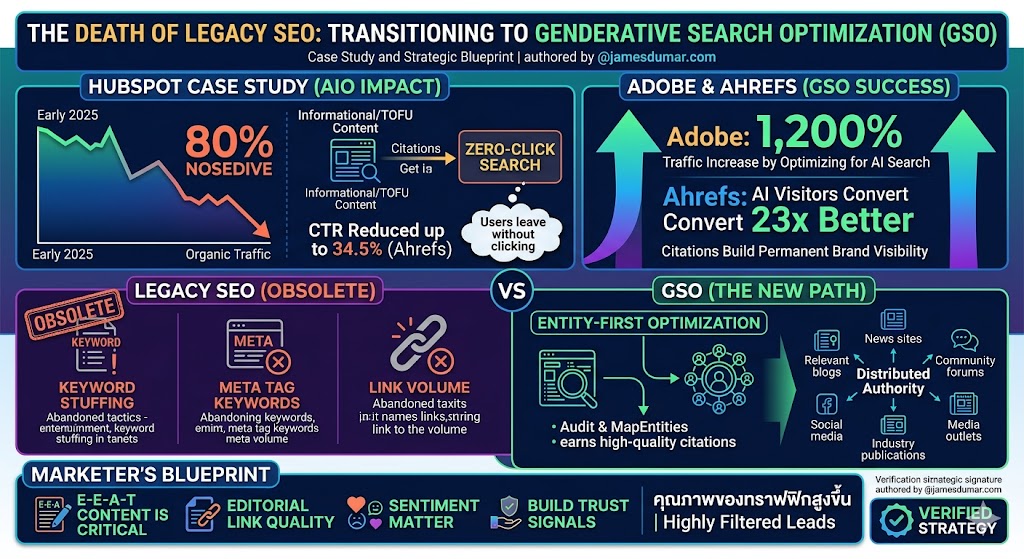
- The HubSpot Nosedive: Following the expansion of AI Overviews in early 2025, digital marketing brand HubSpot saw its organic traffic plummet by approximately 80%.
- The Zero-Click Bottleneck: The steepest declines hit informational, top-of-the-funnel articles, as AI search engines began answering those queries directly inside the main summary block.
- System-Wide Traffic Decay: Industry calculations from Ahrefs confirm that the presence of an AI Overview reduces traditional click-through rates by up to 34.5%.
- The Conversion Silver Lining: Despite shrinking raw traffic, early AI search visitors show high transaction intent, converting up to 23 times better than generic search engine traffic.
The Structural Failure of Legacy SEO in 2025 and 2026
The traditional digital marketing playbook is broken. For over two decades, corporate enterprises treated search engine optimization as an exercise in algorithm manipulation, minor technical tweaks, and keyword repetition. These tactics were explicitly built to reward sites that customized content for robotic index crawlers rather than providing actual value to human readers. Now, with the continuous rollout of high-compute AI Overviews (AIOs) and advanced natural language processing pipelines, these legacy tricks no longer yield results. When an organization builds its digital presence on unstyled data structures or repetitive keyword variations, it creates an incompatible information asset that modern AI search engines systematically filter out. To survive this shift, brands must replace obsolete optimization habits with deeper structural content strategies that align with modern web frameworks, such as the World Wide Web Consortium HTML5 Standard.
The Obsolescence of Keyword Stuffing and Metadata Padding
Keyword stuffing—the practice of overloading paragraphs with target search terms to artificially inflate relevancy scores—has become a major technical liability. Legacy search algorithms historically depended on simple text-string matching to catalog documents. Modern retrieval systems, powered by large language models (LLMs) and deep vector embeddings, analyze the semantic context of an entire page instead. Repeating terms awkwardly ruins content readability and triggers immediate classification penalties from quality filters. Similarly, packing metadata fields with keyword variations offers zero value today. Because modern AI engines can infer true meaning, document layout strategies must prioritize clear, natural information hierarchies that deliver context easily to automated systems, complying with protocols like the IETF RFC 9110 HTTP Semantics Framework.
The Computational Death of Link Volume Over Link Quality
The historical emphasis on building high numbers of medium-to-low-quality backlinks has lost all effectiveness. Legacy search engines looked at total link numbers to determine authority scores, which created a massive market for low-value link-building shortcuts. Modern language models analyze the editorial context and real-world sentiment surrounding a link instead of just counting total connections. A single editorial mention on an authoritative industry site provides far more validation than hundreds of artificial link placements. Focusing on link quantities waste valuable engineering resources and leaves a company vulnerable to algorithmic filtering. Enterprises should pivot toward earned digital PR and high-trust placements to anchor their sites across the web, ensuring alignment with data-first systems like the W3C Architectural Principles of the World Wide Web.
The Value of Real-World E-E-A-T Characteristics
As legacy optimization methods fade, search platforms rely heavily on the core concepts of E-E-A-T: Experience, Expertise, Authoritativeness, and Trustworthiness. AI search engines are built to pull content from entities that show verifiable, real-world experience and clear domain authority. Shallow articles under 700 words often get labeled as thin content and are passed over by citation algorithms. To stay visible inside modern discovery engines, an enterprise must create comprehensive, deeply detailed content assets that show true subject-matter mastery. Building an authoritative, well-researched content portfolio ensures your organization remains a primary citation source for automated search agents everywhere.
The Rise of Generative Search Optimization (GSO)
As legacy search methods lose traction, a new optimization standard has emerged: Generative Search Optimization (GSO). The core objective of GSO is to build strong domain authority with large language models, earning direct brand recommendations and citations within conversational answers. Instead of trying to claim individual keyword rankings on a traditional search results page, companies must format their information footprints to make them easily readable by machine learning pipelines. Earning a citation inside an AI summary exposes your brand name directly to users during critical research moments, generating high-trust brand awareness that drives direct site visits and conversions downstream. This new optimization philosophy builds on standards defined by the Schema.org Vocabulary Consortium.
Implementing Entity-First Architectural Structures
The foundation of GSO relies on entity-first optimization. AI engines interpret the world through Named Entity Recognition (NER), a process that identifies and maps distinct, real-world concepts like specific organizations, products, and leadership teams. To make sure your business is properly indexed, you must catalog and organize all internal brand entities clearly. This work includes auditing how your business profiles are represented in major open data repositories like Wikidata, Crunchbase, Google’s Knowledge Graph, and GitHub. If these reference platforms contain conflicting or outdated details, machine models struggle to map your brand authority correctly. Using clean semantic HTML and advanced schema markup makes your content straightforward for LLMs to interpret, ensuring your corporate entities are accurately recognized and cited during natural language user queries.
Distributing Trust Signals Across Diverse Content Channels
Modern machine systems do not rely on a single website or a concentrated group of links to verify brand authority. Instead, they scan multiple data channels across the digital landscape to cross-reference statements and gauge public trust. Citation systems pull data from news sites, industry blogs, community forums like Reddit and Quora, professional journals, and social media networks. Relying too heavily on one communication channel looks artificial to machine filters and limits your search reach. Building a balanced, cross-platform online presence ensures your company’s trust signals are distributed naturally across the web, satisfying the structural extraction models governed by the W3C JSON-LD 1.1 Specification.
Commercial Implication
Relying on legacy SEO practices introduces a direct financial threat to corporate enterprise value. As automated summaries replace traditional keyword search interfaces, websites that fail to earn AI citations experience sharp declines in organic site traffic. Upgrading to a clean, entity-focused data architecture is a high-return strategic investment that insulates corporate valuation, protects organic reach, and lowers ongoing customer acquisition costs. Implementing a forward-looking GSO framework allows a business to capture dominant visibility inside modern search tools, converting standard technical compliance into a predictable engine for long-term commercial growth.
From Unstructured Traffic Volume to High-Value Conversion Funnels
The transition toward generative search engines changes how marketing leaders analyze traffic quality. High-volume, low-intent informational searches are being replaced by highly targeted, ready-to-buy prospective customers.
| Performance Vector | Legacy Search State | Generative AI Ecosystem |
|---|---|---|
| User Search Intent Filtering | Users must click through multiple surface sites to find basic answers. | AI summaries resolve basic fact-finding lookups instantly on the search page. |
| Inbound Lead Quality | High bounce rates from casual visitors who only need quick definitions. | Highly filtered traffic consisting of users who need complex business services. |
| Long-Term Conversion Value | Lower average transaction values from broad, unfocused traffic streams. | Significant revenue gains, with AI traffic converting up to 23 times better. |
- Filtering the Chaff: Automated answers handle quick informational queries directly, filtering out low-intent lookups before they reach your site.
- Adobe’s Success: Businesses that adapt early see massive growth; Adobe achieved a 1,200% traffic increase by optimizing for AI discovery systems.
- Sovereign Digital Infrastructure: Monitoring the shift since 2022 allows specialized teams to build dedicated GSO systems for corporate clients.
- Permanent Visibility: Moving past legacy tracking systems helps a company build long-term authority inside automated machine indexes.
Re-Engineering Content Strategies for Zero-Click Environments
The rise of zero-click searches—where a user finds an answer directly inside an AI overview without clicking any website results—has caused widespread concern among digital marketers. However, deeper analysis reveals that losing casual, informational traffic does not hurt bottom-line business revenue. Most zero-click lookups come from users who were looking for simple definitions and had no intention of buying a product or service. Losing this low-value traffic clears up server bandwidth and gives an organization a clearer view of its actual sales pipeline. For top-tier informational articles, appearing as a cited source in an AI summary introduces your brand to users at the start of their research phase, building long-term equity across the digital landscape.
The Strategic Value of Modern Digital PR
In a GSO environment, digital PR serves as an effective methodology for building domain trust. Traditional link acquisition methods often relied on low-cost content farms or paid directory placements, which modern language models easily recognize and ignore. High-signal digital PR focuses on securing brand mentions and contextual article placements on recognized, high-authority news platforms and industry publications. When an AI index crawler finds your brand recommended across multiple independent, high-trust domains, it updates its internal entity graph to rank your business as a trusted market leader. This validation protects your search visibility and ensures your business remains a primary recommendation for related natural language prompts.
Analyzing Community Brand Sentiment and Reviews
Modern machine systems look far beyond basic on-page text to evaluate an organization’s actual market reputation. AI crawlers systematically track reviews, customer testimonials, and conversations on popular community platforms like Reddit and Quora to evaluate overall brand sentiment. If a business features strong technical optimization but suffers from poor user feedback or negative forum discussions, citation models drop the domain from their recommendation lists. Maintaining high operational standards, responding to customer issues, and keeping an active profile on consumer review networks are essential tasks for modern technical marketing teams.
The Imperative of Immediate Infrastructure Alignment
Our team has monitored the evolution of generative search frameworks since early machine learning tools debuted in 2022. This continuous research has guided the development of our specialized GSO service line. We provide comprehensive digital PR strategies to earn high-tier editorial placements, advanced reputation management tools to maintain positive sentiment tracking, and targeted AI discovery systems to maximize your brand citations across modern search platforms. Implementing these advanced technical services protects your business against shrinking organic search traffic, keeps your content highly relevant, and builds sustainable customer acquisition pipelines across the modern web infrastructure.
Executive Synthesis
Abandoning old-school SEO shortcuts to adopt a forward-looking GSO strategy is an essential step for modern enterprise leadership. As automated systems become the primary channel for web discovery, older websites that rely on keyword manipulation will continue to lose market presence. Rebuilding your site with clean entity formatting, strong editorial link profiles, and distributed trust networks turns your digital footprint into an accessible, machine-ready information hub. This investment enhances brand presence inside digital knowledge graphs, minimizes customer acquisition friction, and drives long-term conversion growth. Updating your technical infrastructure preserves your competitive advantage and transforms digital compliance into a reliable source of enterprise value.
“`